
The most expensive seating mistake on a project is buying by job title: executive chairs for managers, task chairs for everyone else. Back height is a function of how long someone sits and what they do while sitting — and it also changes carton volume, freight per unit and how many chairs fit in the container. Choose by task, then check what the choice does to the shipment.
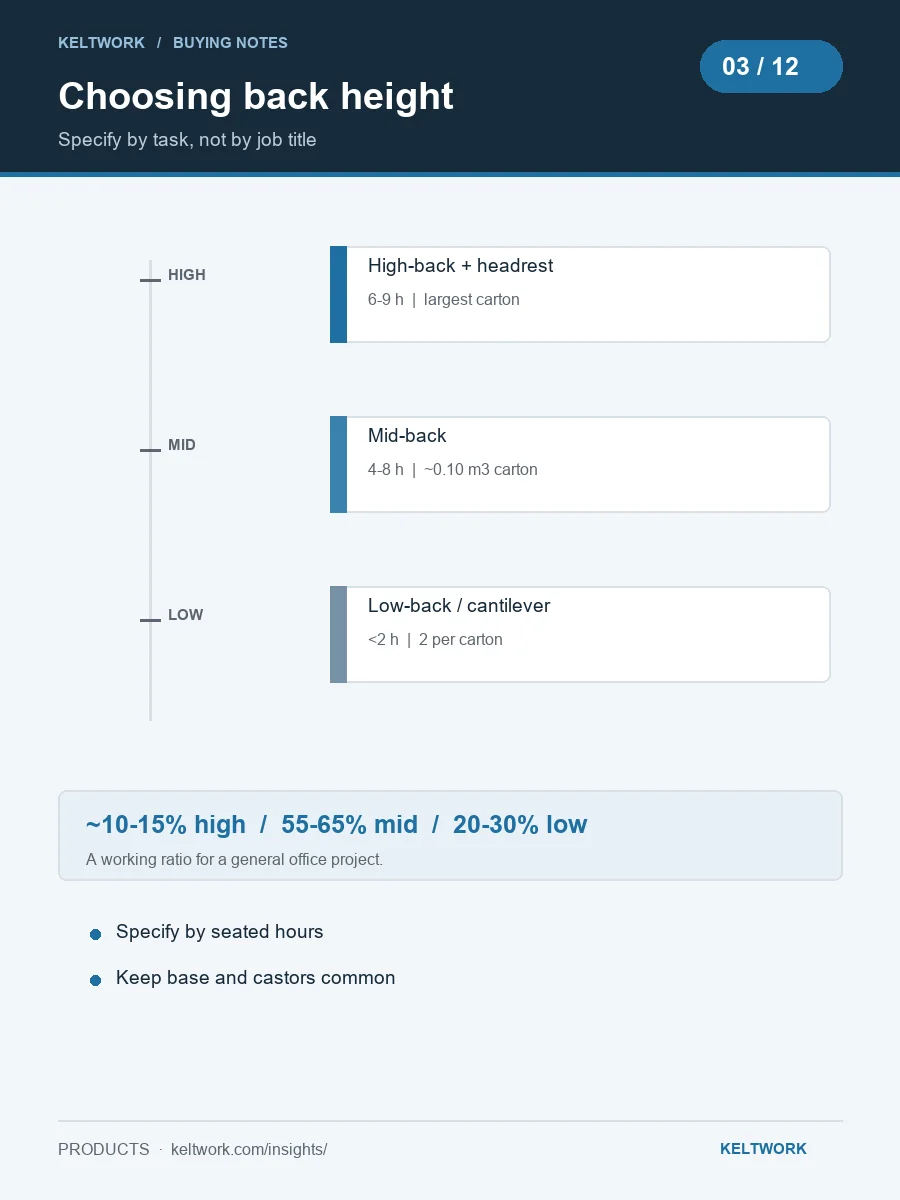
Three heights, three jobs
| Back height | Typical seated pattern | Where it belongs | Carton effect |
|---|---|---|---|
| High-back with headrest | 6–9 hours, frequent recline, screen-heavy work | Executive offices, control rooms, long-shift stations | Largest carton; fewer pieces per 40HQ |
| Mid-back | 4–8 hours, upright posture, mixed tasks | General offices, shared desks, hot-desking | Baseline carton around 0.10 m³ |
| Low-back / cantilever | Under 2 hours, short meetings, visitor use | Meeting rooms, training rooms, reception | Flatter carton, often 2 chairs per carton |
These are working ranges, not rules. A tall user at a shared desk may need a high back; a manager who spends the day in meetings does not. What matters is the recline cycle: a headrest is useful when someone actually leans back, and is dead weight when they sit upright for forty minutes at a time.
Why specifying by title inflates the order
A 200-seat project with twenty “manager” chairs often ends up with twenty high-back models bought at a premium, then sits them in offices where the occupants are in meetings most of the day. Meanwhile the eighty people doing eight hours of screen work get mid-backs with no headrest. The budget is spent on status rather than on the people with the most seated hours.
There is a freight penalty too. High-back chairs pack into a taller carton — a typical high-back export carton is around 0.15–0.17 m³ against roughly 0.10 m³ for a mid-back. On 600 chairs that difference can move the container count. If you are planning mixed loads, the arithmetic is in our note on 40HQ loading.
Read the family, not just the model name
Most chair series are built as three variants: an A (high-back), a B (mid-back) and a D (cantilever or fixed base) sharing the same back frame, mesh, seat mould and base. That is useful for a project specification because the visual language stays consistent across floors while the function changes — and spares stay common.
Compare the A191-H high-back, the A191 mid-back and the A010 low-back operator chair. The difference in spec is mostly back height and headrest, and the difference in the packing list is mostly carton height. Specifying all three on one project gives you a coherent look without paying for headrests in meeting rooms.
Practical ratio for a general office: roughly 10–15% high-back, 55–65% mid-back, and 20–30% low-back or cantilever for meeting and visitor areas. Adjust after a seating audit, not before.
The adjustability question
Back height is only one axis. Seat height range, seat depth, lumbar position and arm adjustment decide whether a chair actually fits the people using it — which matters more in shared-desk environments than in assigned offices. Our note on seat depth, lumbar support and mesh tension covers the measurements worth writing into a specification.
For hot climates, the back material matters as much as the height: a full mesh back behaves differently from an upholstered one over three years of humidity. That trade-off is covered in mesh or fabric seat.
How to write the specification
- Define by use, not by role. “Seating for 8-hour screen work” and “seating for meetings under 90 minutes” are specifications; “manager chair” is not.
- Name the variant per area. Give a model number for each zone and a count for each, so the quotation cannot silently upgrade a room.
- Ask for carton dimensions per variant. The freight difference between a high-back and a cantilever is real and belongs in the landed-cost comparison.
- Keep the family common. Shared bases, castors and gas lifts simplify the spare-parts list for the whole project.
Check the sample in the actual room
A high-back chair that looks right in a showroom can dominate a small office, and a low-back visitor chair can look under-specified in a formal boardroom. Approve one sample of each variant in the intended room, with the intended desk height, before releasing the full production quantity. It is the cheapest way to catch a specification that is technically correct and practically wrong.
Tell us the room types and seated hours on your project and we will propose a per-zone model mix with carton volumes for each variant.
Ask a questionBrowse modelsRelated models
Full specifications and packing data for the chair types discussed above.