
Armrests look like a comfort option and behave like a cost and packaging decision. Fixed PP arms, PU-padded arms and multi-directional adjustable arms differ in part count, assembly labour, carton volume and warranty exposure. On a project order, that combination is often the difference between two quotations that otherwise appear to describe the same chair.
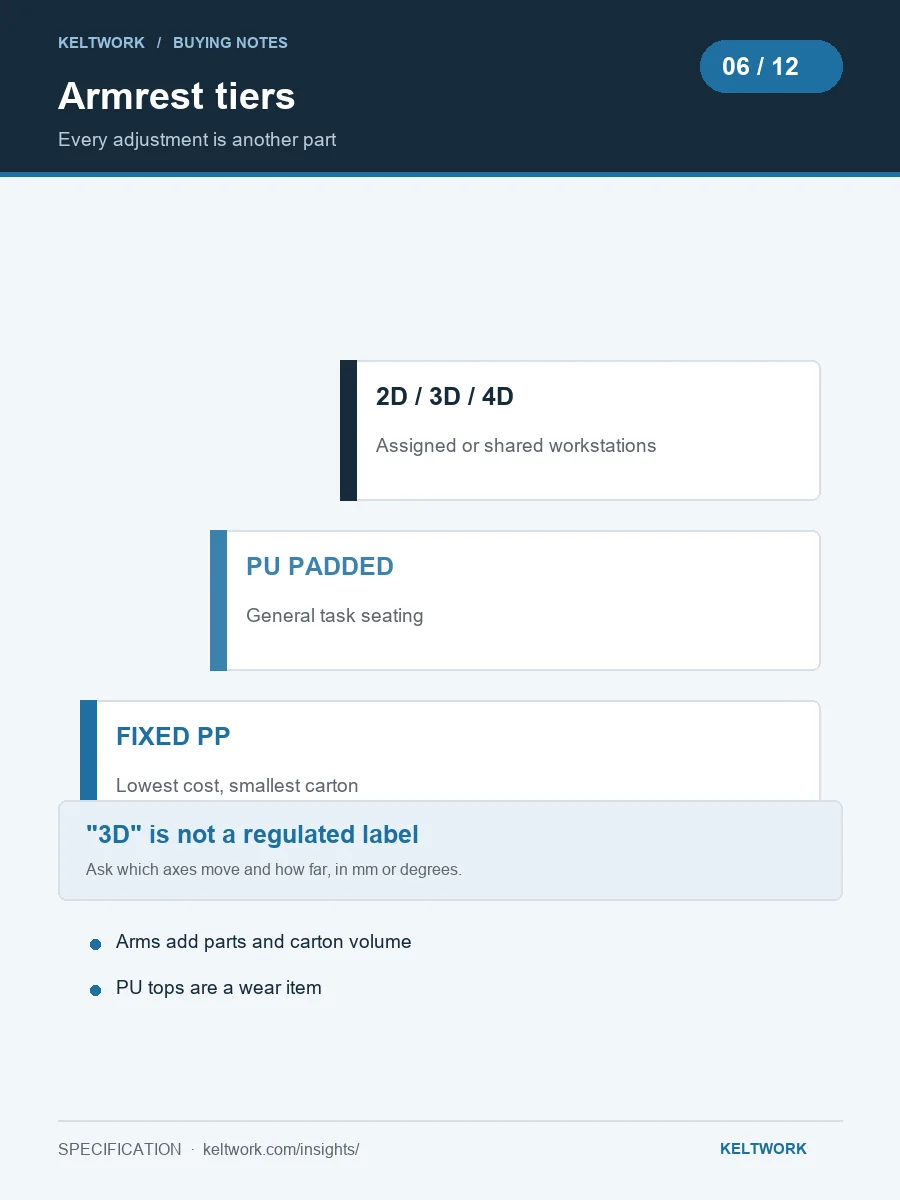
The three common tiers
| Arm type | Construction | Where it fits | Cost / packing effect |
|---|---|---|---|
| Fixed PP | Single moulded polypropylene arm, bolted to the seat frame | Meeting rooms, training, visitor and short-stay seating | Lowest cost, smallest carton, fewest parts |
| PU padded | PP or steel core with a moulded polyurethane top | General task seating, 4–8 hour use | Moderate cost; PU surface is a wear item |
| Adjustable 2D / 3D / 4D | Sliding height, depth, width or pivot mechanisms | Assigned workstations, shared desks, ergonomic tenders | Higher cost, more parts, larger carton, more warranty exposure |
“2D”, “3D” and “4D” are not regulated labels. One supplier’s 3D arm adjusts height, depth and pivot; another’s adjusts height, width and depth. Ask for a list of the axes and the travel in millimetres or degrees. A tender that asks for “3D armrests” without defining them can be satisfied by two very different products.
Where the cost actually appears
The unit price is only the first line. An adjustable arm adds a separate assembly step, a parts bag, and usually a wider or taller carton because the arms are shipped detached for knock-down packing. That carton change flows straight into the container quantity. On a 600-chair order, a 2 cm increase on one dimension can be worth more in freight than the arm upgrade costs per unit — the calculation is the same one in reading a packing list.
There is also a warranty line. An adjustable arm has sliding parts that can develop play or lose their lock; a fixed PP arm has almost nothing to fail. In a training room used two hours a day, the adjustable arm buys little and adds a failure mode. In a shared desk used by three shifts, it buys real fit.
Specify by use, not by tier: fixed PP for rooms with short seated time; PU padded for general task seating; adjustable only where users work long hours at an assigned or shared workstation and the tender requires it.
Reading an arm line in a real range
Spec sheets from Foshan factories often write “PP扶手” — literally “PP armrest” — as a single field, with no height, no load rating and no indication of whether it is fixed. Compare the A191 mid-back, the A010 low-back operator chair and the 1701B: similar price band, different arm and back specifications, and different cartons. Ask the supplier to state the arm height from the seat, the arm-top material and the fixing method for each.
If two quotations differ by a dollar a chair and both say “PP arm”, check whether one includes a PU pad or a height slider. That is a common place for a line-by-line quotation comparison to find a hidden difference.
The measurements worth writing down
- Arm height above the seat in mm, and the adjustment range if adjustable.
- Arm-top length and width, and the material of the contact surface (PP, PU, soft-touch coating).
- Distance between the inner edges of the two arms — the number that determines whether the chair fits under a desk or a user.
- Fixing method and bolt size, plus whether the arms are factory-fitted or installed at destination.
- Load test for a vertical and a lateral load on the arm top.
PU is a wear item
Polyurethane arm pads are comfortable and look better than bare polypropylene, but they are the first surface to show wear in a hot, humid climate — softening, tackiness or a peeling skin after a couple of years. If a project specifies PU, ask what grade is used and whether spare pads are available as a part. Keeping a small quantity of arm tops in the spare-parts carton is cheaper than replacing assemblies later; our warranty and spare parts note covers how to size that.
One sample check
Sit at the intended desk with the sample chair, rest both forearms, and check three things: whether the arms clear the desk edge, whether the height lets the shoulders relax, and whether an adjustable arm holds its position under firm downward pressure. Ten minutes at a real desk will tell you more about an arm specification than a page of component codes.
Tell us the room type and seated hours and we will recommend an arm specification with the carton and cost impact shown separately.
Ask a questionBrowse modelsRelated models
Full specifications and packing data for the chair types discussed above.