
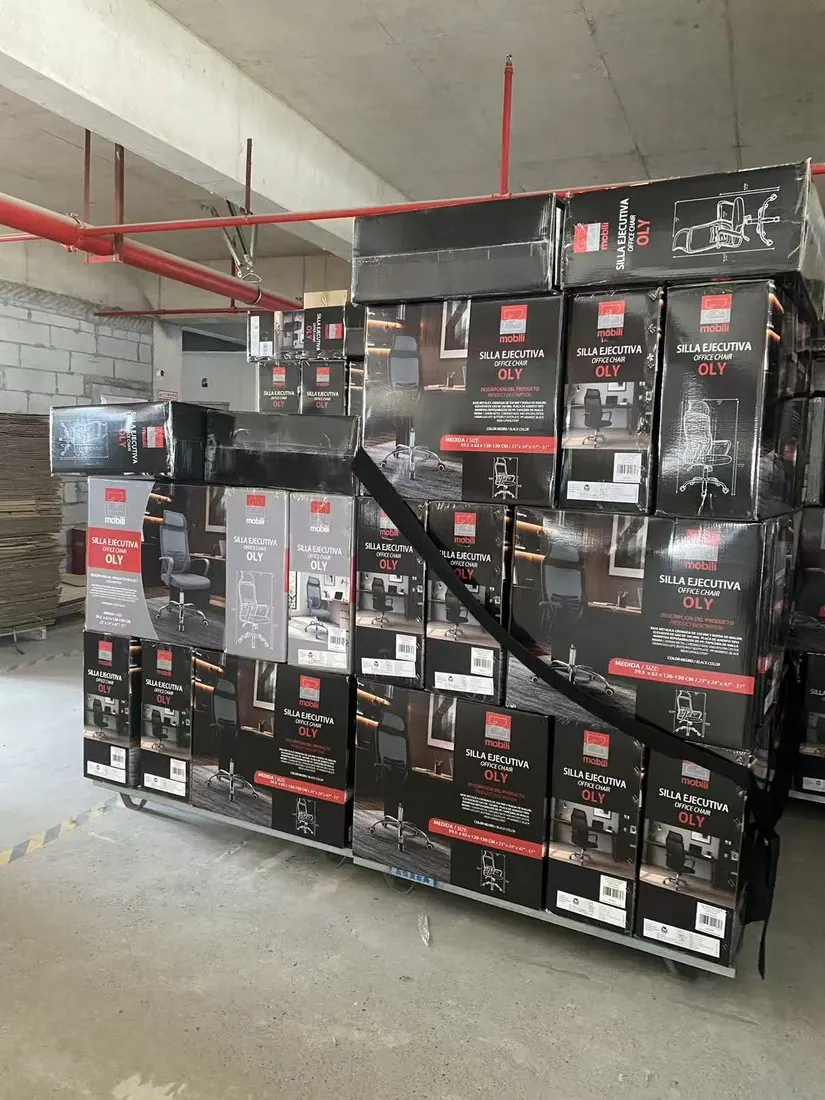
The short answer for a mid-back mesh task chair is 520 to 620 pieces in a 40HQ. For a high-back executive chair it is closer to 360. For a cantilever or a stacking chair it can pass 900. The gap between those numbers is not the chair. It is the carton.
Four numbers decide the answer
Container loading is arithmetic, not experience. Anyone can check a supplier’s claim in five minutes with four numbers:
- Usable volume inside the container. A 40HQ measures 12.03 × 2.35 × 2.69 m internally, which is about 76 m³. Nobody loads 76 m³. Deductions for the door frame, the corrugation, and the fact that the last row never sits perfectly flush leave 66 to 70 m³ of practical space.
- Carton volume of one piece. Length × width × height in metres, three decimal places. Not the chair, the carton.
- The fill rate you are willing to accept. 0.85 is a realistic figure for a well-planned load of uniform cartons. Below 0.80 you are paying for air.
- The weight limit. For a 40HQ it is around 26,000 kg of payload, and most carriers will not let you near that on a chair order.
The calculation is then:
Pieces per container = (usable m³ × fill rate) ÷ carton m³
Example: (68 × 0.85) ÷ 0.112 = 516 pieces.
What the carton actually measures
The table below uses carton sizes we see most often on export orders from Foshan. Treat them as a starting point to compare against a supplier’s packing list, not as a specification for any particular model.
| Chair type | Typical carton (cm) | m³ per carton | Pieces per 40HQ* |
|---|---|---|---|
| Mid-back mesh task chair, KD | 62 × 60 × 30 | 0.112 | 520 – 600 |
| High-back executive chair, KD | 72 × 66 × 36 | 0.171 | 340 – 390 |
| Cantilever / meeting chair | 58 × 56 × 26 | 0.084 | 690 – 780 |
| Stacking chair, 6 per carton | 108 × 60 × 58 | 0.376 | 900 – 1,050 |
| Visitor chair, four-leg, KD | 56 × 54 × 24 | 0.073 | 790 – 880 |
*At 66–70 m³ usable and 0.85 fill. The lower figure assumes cartons are palletised, the higher assumes floor-loaded.
Why pallets quietly cost you 8%
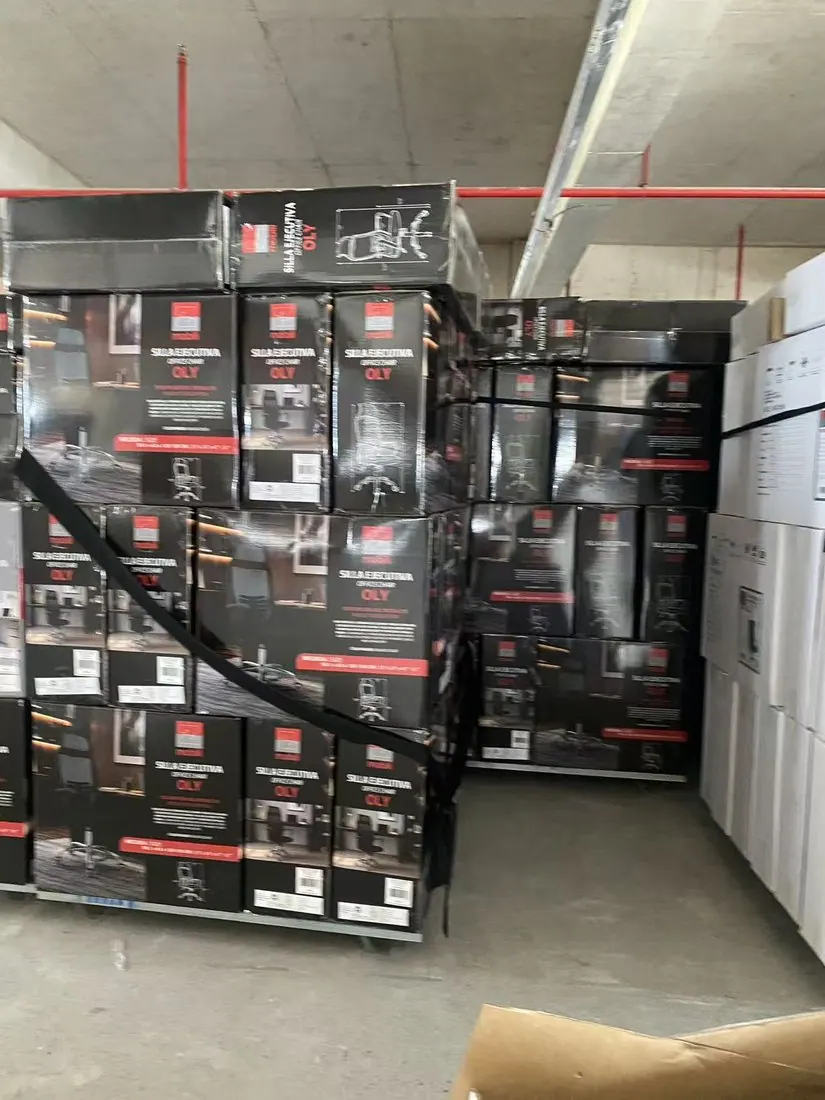
Palletising a container is easier to unload and easier to count. It also consumes volume: a standard 1200 × 1000 mm pallet with 120 mm of clearance around it removes roughly 7 to 10% of the usable cube, and the top of the stack is never fully used.
On a 550-piece order that is 40 to 55 chairs. If your customer’s warehouse has a forklift and a dock, floor loading is usually the better trade. Old cartons with soft corners, on the other hand, need the pallet — floor-loaded soft cartons crush at the bottom rows after ten days at sea.
The weight limit almost never binds
A mesh task chair of this class ships at 11 to 15 kg including the carton. Six hundred pieces is 7 to 9 tonnes. The container will be full long before it is heavy. This is the single most useful fact about chair freight: chairs cube out, they do not weigh out, which means every centimetre of carton is worth more than every kilogram of product.
It also means light-weighting a chair — thinner foam, a nylon base instead of die-cast aluminium — buys you nothing on freight. Only the carton matters.
The USD 2 per unit nobody puts on the quotation
Two chairs with the same FOB price per unit can land at different costs per unit. The mechanism is simple. Take a 40HQ from Shenzhen to Rotterdam at USD 3,000:
- A 0.100 m³ carton at a good fill gives 578 pieces. Freight per chair: USD 5.19.
- A 0.135 m³ carton, same chair, packed with extra foam and a bigger base bag, gives 428 pieces. Freight per chair: USD 7.01.
That is USD 1.82 per chair, created entirely by 35 mm of carton. Multiply it by 20,000 pieces a year and it is a salary. Suppliers rarely volunteer this because the carton is designed by the packing department, not the sales department, and nobody compares carton drawings between two quotations.
How to audit a packing list in five minutes
Ask for the packing list before you approve the proforma invoice, then do this:
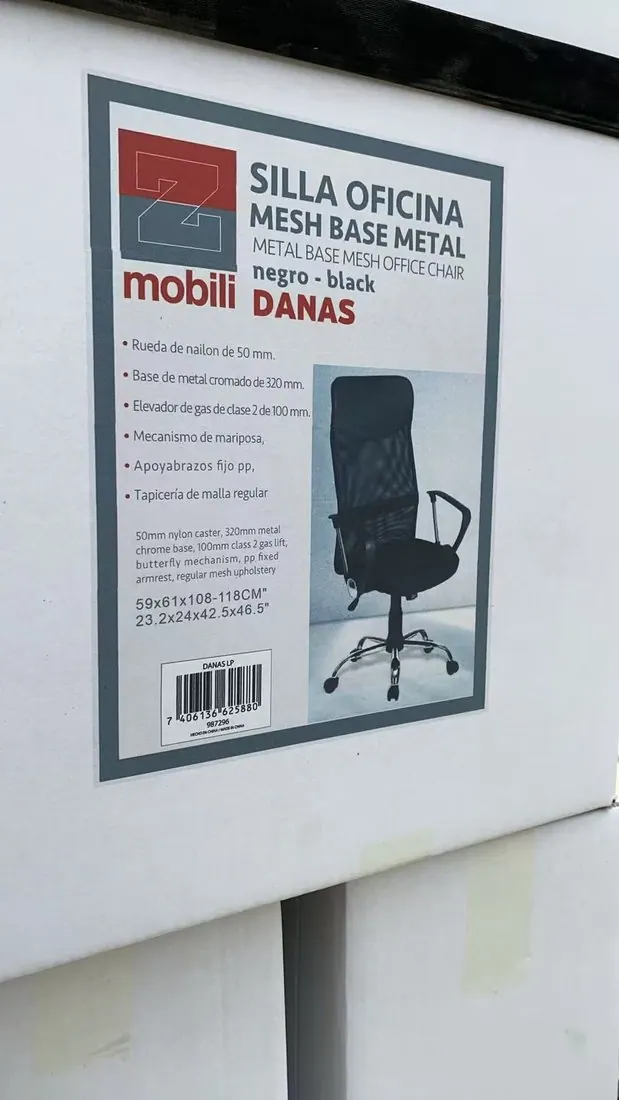
- Multiply the three carton dimensions yourself. Do not trust the CBM column — it is where transcription errors live.
- Divide 58 by the carton CBM. That is your realistic ceiling at 85% fill of 68 m³. If the supplier claims more, ask what the fill rate is.
- Check the gross weight against the volume. A 0.11 m³ chair carton weighing 22 kg is not a chair, it is a chair plus a steel base packed badly.
- Ask whether the base is inside the main carton or strapped outside. An outside base adds a second handling unit and usually 4 to 6% volume.
- Ask for the carton photo with a tape measure against the side. It takes the factory one minute and settles the argument.
Knock-down is not a cost saving, it is a freight decision
Almost every export chair ships KD: base off, casters in a bag, gas lift in its own sleeve, back separated from the seat on high-back models. Assembly at destination takes 6 to 12 minutes with one Allen key.
The alternative — assembled, or semi-assembled with the base on — doubles the carton for a task chair. It exists for two reasons only: the buyer has no assembly labour, or the buyer is a retailer who needs shelf-ready product. Both are valid, and both cost 30 to 50% more per unit in freight. Decide it deliberately, not by accident.
What belongs in the purchase order
Four lines prevent most loading disputes:
- Carton dimensions and CBM per carton, as an agreed figure with a stated tolerance of ±1 cm.
- Pieces per 40HQ, stated as a minimum, with the formula that produced it.
- Loading photographs: carton count per row, container number, seal number.
- Who pays if the shipped quantity falls below the stated minimum because cartons were larger than declared.
That last line is the one that gets used.
If you want a packing list checked against your own container plan, send the carton dimensions and the quantity — we will run the numbers and tell you where the volume is going.
Ask a questionMore notes