
“Ergonomic” is the most overused word in a chair catalogue. Three measurements — seat depth, lumbar position and mesh tension — separate a chair that fits the people using it from one that merely has a label. They are also the three least likely to appear on a standard specification sheet, which is why they need to be asked for by number.
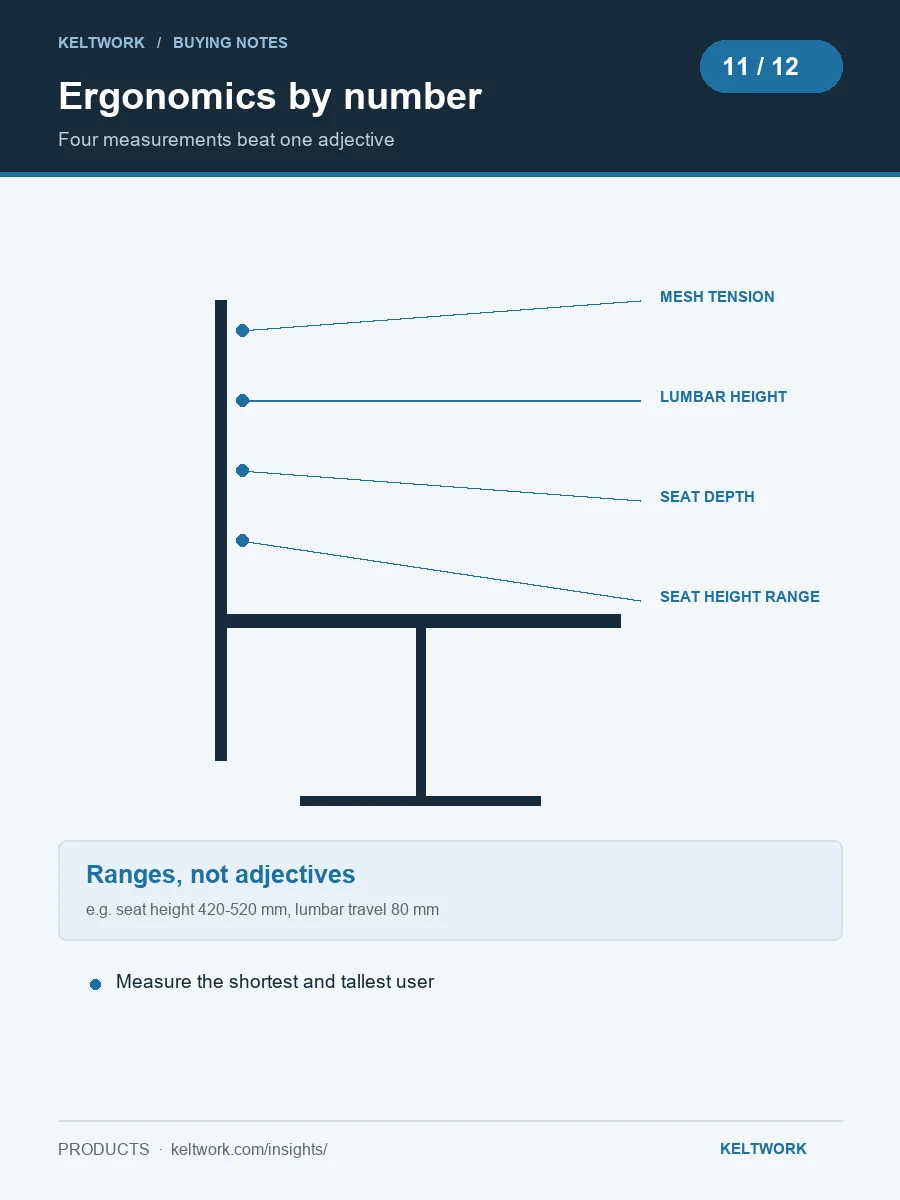
Four numbers worth asking for
| Measurement | Why it matters | How to check it |
|---|---|---|
| Seat depth | Too deep presses into the back of the knees; too shallow leaves the thighs unsupported | Measure from the front edge to the backrest at the seated surface; ask whether it adjusts and by how much |
| Seat height range | Determines whether feet rest flat for the shortest and tallest users | Measure floor to seat top at lowest and highest gas lift positions |
| Lumbar height and depth | Support has to land at the user’s lower back, not at their shoulder blades | Measure the height of the support above the seat and its protrusion; note whether it adjusts |
| Mesh tension | A back that has gone slack stops supporting within a year or two | Ask for the mesh specification and a deflection figure; press the sample firmly and compare after cycling |
These are measurable, and a factory that has built the chair can give them in a day. A supplier who answers only with “fully ergonomic” has told you that the marketing copy exists, not that the dimensions have been considered.
Put the ranges in the tender, not the adjectives. “Seat height 420–520 mm, seat depth 460–490 mm or adjustable, lumbar support height adjustable over 80 mm” is a specification a sample can be checked against.
Shared desks change the answer
In an assigned office, a chair is fitted to one person once. At a shared desk used by three shifts, the same chair has to fit many people in a day, so adjustability becomes worth paying for: a wider seat height range, a depth-adjustable seat or a sliding seat, and a lumbar support that moves. Fixed-fit chairs are not worse chairs — they are just fitted to a different usage pattern.
That is the same logic as choosing by task rather than job title. Decide the seated duration and the number of users first, then choose the adjustment range. Buying maximum adjustability for a meeting room used forty minutes at a time mostly buys parts that can fail.
Mesh tension is a durability question
A mesh back is a tensioned membrane. The frame, the mesh grade and the way the mesh is fixed into the frame decide whether it holds its shape. Ask what the mesh is, how it is attached, and what deflection is permitted under a stated load. Then press the sample firmly two hundred times and compare it with a fresh one. A back that visibly softens in five minutes will not hold up for three years.
Humidity compounds this. The seat foam and the upholstery behaviour in hot climates are covered in mesh or fabric seat and in reading a foam specification; both are worth reading alongside the back specification, because the user experiences the two together.
Where these numbers differ across a range
Compare the A191-H high-back with headrest, the A841-H executive mesh chair and the A191 mid-back. The seat geometry is similar, but the back height, headrest and lumbar treatment change who each chair suits. For a project, that is a useful combination: one seat platform, several back options, and a spare-parts list that stays common across the fleet.
Arm height belongs in the same measurement set — the inner distance between the arms and their height above the seat determine whether the chair works at the intended desk. That is covered in armrest specifications.
How to approve the sample
- Measure the four numbers on the sample and record them on a single sheet with the model code.
- Have the shortest and tallest actual users sit at the intended desk height, with feet flat and forearms on the arms.
- Cycle the recline and press the mesh, then re-measure. Anything that changed in ten minutes is a durability risk.
- Photograph the measuring setup, and attach the sheet and photos to the purchase order as the reference.
- Ask for the same four numbers on three random chairs from the production run at inspection.
What to leave out
Some features sold as ergonomic are difficult to verify and easy to market: a “breathable” layer with no airflow data, a “dynamic” back with no stated range of movement, or a lumbar pad with no height adjustment. They are not necessarily bad — they are simply not specifications. If a feature cannot be measured or photographed on the sample, keep it out of the tender and out of the price comparison.
Tell us the user height range and desk height on your project and we will recommend models with measured seat and lumbar ranges for each zone.
Ask a questionBrowse modelsRelated models
Full specifications and packing data for the chair types discussed above.