
A seat specification such as “4CM 再生绵 + 1.5CM 30纯绵” is precise-looking shorthand that most buyers never decode. It describes thickness, not density; it mixes two different foam types; and it says nothing about how the seat will feel after three years in a humid climate. Here is how to read it and what to write instead.
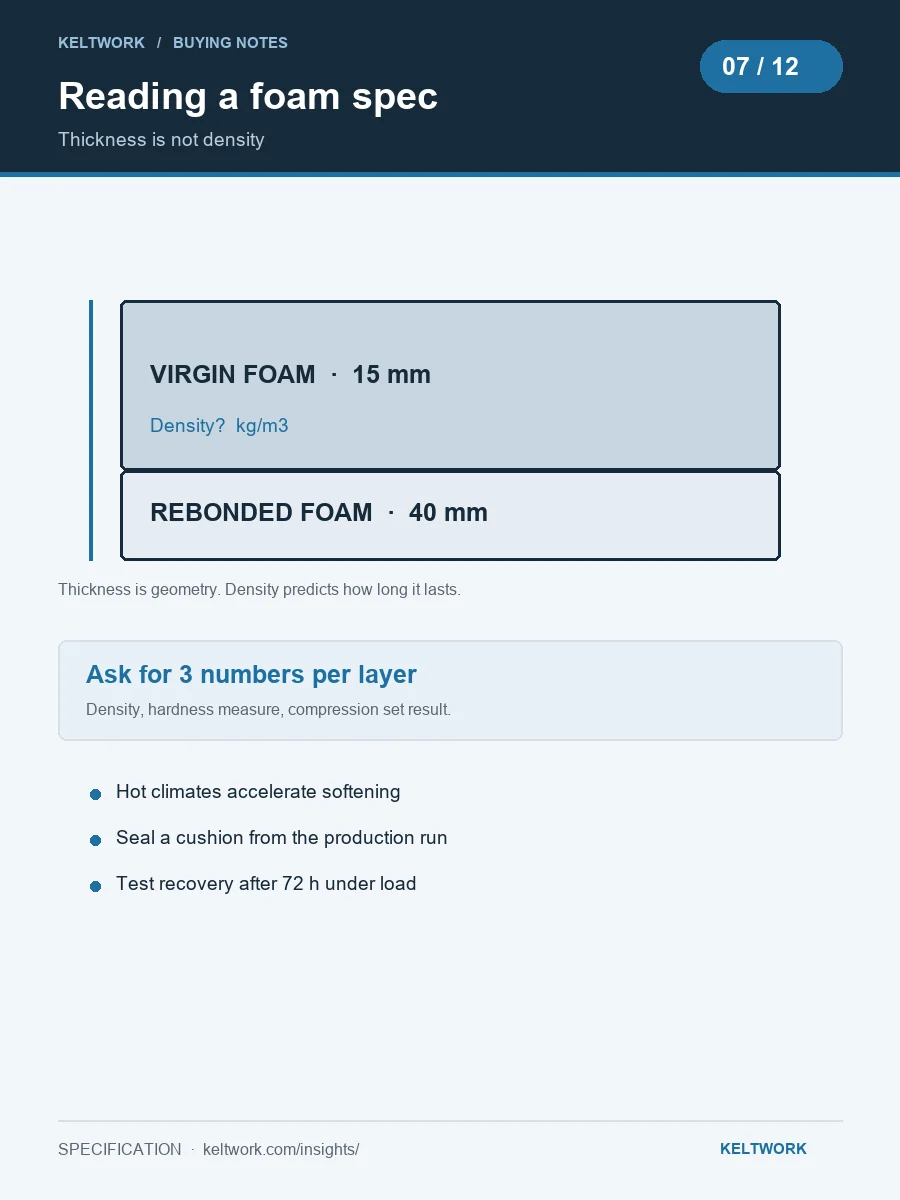
What the shorthand means
| Phrase on the sheet | Literal meaning | What it does not tell you |
|---|---|---|
| 再生绵 | Recycled / rebonded foam, made from compressed offcuts | Density, hardness, binder quality |
| 纯绵 | Virgin foam, usually a moulded or slab top layer | Density, resilience, grade |
| 30 | Commonly a density grade in kg/m³, sometimes a hardness code | Which of the two the supplier means |
| 4CM + 1.5CM | Layer thicknesses, 40 mm and 15 mm | Compression set, load-bearing behaviour, long-term sag |
Rebonded foam is dense, firm and cheap, and works well as a structural base layer. Virgin foam is more resilient and more comfortable as the contact layer. Layering the two is a legitimate, common construction: it puts the cheap material where it is not felt and the better material where it is. The problem is that the shorthand gives layer thickness but not the property that determines durability.
The number to ask for is density in kg/m³, per layer. Follow it with indentation force deflection (or the supplier’s equivalent hardness measure) and a compression set result. Thickness alone tells you almost nothing about how a seat ages.
Density, hardness and thickness are three different things
Density is mass per volume. Hardness is how much force it takes to compress the foam. Thickness is just geometry. A 40 mm layer of low-density foam can feel soft on day one and flatten within a year; a thinner layer of higher-density foam can outlast it and feel firmer. When a supplier offers “thicker foam” as an upgrade, ask whether density changed — if not, the upgrade is cosmetic.
Compression set is the measure that matters most for a chair that is sat on eight hours a day: after sustained compression, how much of the original thickness does the foam recover? Ask for the test method and the result for the exact foam grade in your order, not for the factory’s general catalogue.
Why hot climates are harder on seats
Heat and humidity accelerate two failure modes: softening and loss of resilience in the foam, and hydrolysis in some polyurethane formulations and in the adhesive bond between layers. A seat that passes a showroom test in a temperate office can feel noticeably flatter after two summers in a tropical one. This is the other half of the mesh versus fabric question — airflow helps the user, but it does not protect the foam underneath.
For humid markets, ask about the foam formulation’s hydrolysis resistance, and consider a full mesh seat where the project allows it. For upholstered seats, a higher-density top layer and a documented compression set result are the two lines worth paying for.
Where the spec shows up in a real range
Seat construction is one of the fields that separates a mid-back task chair from an executive model at a visibly different price point. Compare the A191-H, the A841-H and the 1701B: the arm, back and base lines differ, but the seat build is the one most likely to be described in shorthand. Ask each supplier to restate the seat line in density and thickness per layer, and the differences become comparable.
The same discipline applies to the upholstery above it: fabric grade, abrasion cycles and colour fastness belong in the same table. Arm-top material belongs next to it too — see our note on armrest specifications.
How to write the seat line
- Per-layer specification: “Base layer: rebonded foam, [X] kg/m³, [Y] mm. Top layer: virgin foam, [Z] kg/m³, [W] mm.”
- Hardness: the supplier’s measure with the test method named, and the acceptable range.
- Compression set: test method, duration, temperature and the maximum permitted loss.
- Board and frame: plywood thickness and grade, since the foam sits on it and a flexible board makes any foam feel worse.
- Reference sample: a sealed, signed cushion from the approved sample, kept at both ends for comparison.
The test you can do in a warehouse
Put a flat board and a known weight on the sample seat for 72 hours, measure the thickness before and after, and measure again 24 hours after the weight is removed. It is not a laboratory test, but it catches the most common problem — foam that does not come back — before 600 chairs are shipped. Do it on the production sample, not the showroom sample.
Seat complaints are among the hardest warranty claims to resolve because comfort is subjective. A density figure, a compression set result and a sealed sample turn a subjective argument into a measurable one.
Send us the seat line from a Chinese specification and we will restate it in density, hardness and compression terms you can put in a purchase order.
Ask a questionBrowse modelsRelated models
Full specifications and packing data for the chair types discussed above.