
Two quotations for “the same” office chair rarely describe the same object. One includes a Class 3 gas lift, the other a Class 2; one quotes a 61 x 28 x 59 carton, the other a slightly larger one; one is EXW, the other FOB. Put them into a single line-by-line table and the cheaper quote often stops being cheaper.
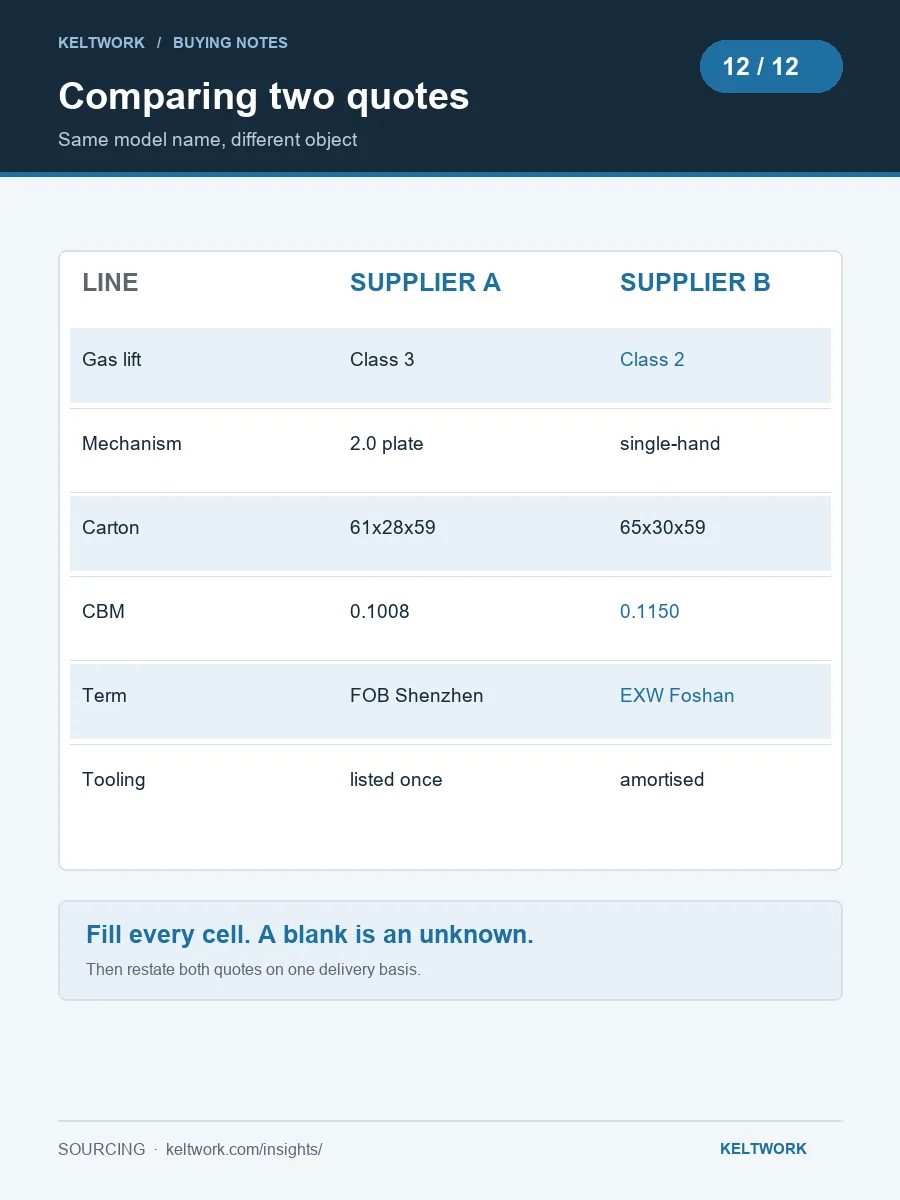
Build one comparison table, not two files
Create a single sheet with the specification field in the first column and one column per supplier. Every cell must be filled. A blank is not “the same as the other one” — it is an unknown, and unknowns are where substitution happens.
| Line | What to record | Why it changes the price |
|---|---|---|
| Model & configuration | Exact code, back height, headrest yes/no, arm type | A headrest or adjustable arm is a different bill of materials |
| Gas lift | Class, stroke, maker or part number | Class 2 vs Class 3 is roughly a dollar a chair and a different failure curve |
| Mechanism | Part number, plate gauge, lock positions | The most common hidden substitution on a chair |
| Base & castors | Material, span in mm, wheel and stem size | Aluminium and wider bases carry real cost |
| Seat build | Foam density per layer, board thickness, upholstery grade | “Thicker foam” often means cheaper foam |
| Carton & CBM | Three dimensions, pieces per carton, gross weight | Determines freight per chair and container count |
| Term & named place | Incoterms rule, year, port, what is included | EXW, FOB and CIF are not comparable unit prices |
| Tooling, packaging, samples | One-off charges, carton printing, sample freight | Often amortised silently into the unit price |
| Lead time & payment | Production days, deposit balance, credit terms | Cash cost is a real cost, especially with a new supplier |
Convert everything to one delivery point
Before comparing the unit price, restate both quotes on the same term — FOB Shenzhen is usually the most convenient baseline. Then add ocean freight per chair, insurance, destination charges, duty and inland delivery. Freight per chair is a function of carton volume, so use the CBM on each quote rather than a shared estimate: a 0.1008 m³ carton and a 0.112 m³ carton can differ by more than fifty chairs per 40HQ.
Our notes on FOB, EXW and CIF and on 40HQ loading give the two halves of that calculation. The five packing-list fields to verify are in reading a packing list.
Landed cost per chair = unit price at the chosen term + (ocean freight + insurance + destination charges + duty) ÷ pieces per container + inland delivery. Compare that number, not the FOB line.
Where “same model” stops being true
Model codes are not globally standard. Two factories can both quote a “2002A” with different arms, a different chassis and a different carton. Even within one supply chain, a high-back and a mid-back variant share a family number but not a specification. Compare the 2103A and the 2002A: both high-back mesh chairs, different mechanism lines, and a real price difference that a single model name would completely hide.
The remedy is to attach a component sheet to the quotation. Ask each supplier to fill in the same table you built, with part numbers where they exist. If one refuses, that gap is itself a finding.
Samples and sealed references
- Request samples built to the quoted specification, not the showroom version, and label each with the quotation reference.
- Photograph the underside — mechanism, gas lift marking, base moulding — for each sample.
- Seal or sign one sample per supplier and keep it at the factory as the production reference.
- State in the PO that no component may be substituted without written approval, and attach the comparison table as an annex.
Our inspection note explains how to check three random production units against that reference before shipment.
Read the MOQ and the payment terms together
A low unit price attached to a 1,000-piece minimum is not comparable to a slightly higher price at 200 pieces if your project needs 200. The same applies to a 50% deposit with no inspection clause versus 30% with balance after inspection. The arithmetic behind minimum quantities is in what MOQ really means, and the tooling question is in OEM or ODM.
A five-minute sanity check
- Are all cells in the comparison table filled, with no blanks?
- Are both quotes on the same Incoterm with the same named place?
- Do the CBM figures multiply correctly from the three carton dimensions?
- Has tooling been listed once, rather than amortised invisibly?
- Is there a named sample reference and a no-substitution clause in the draft PO?
Most buyers find the answer to at least one of those questions changes the ranking. That is the whole point of doing the table.
Send us two quotations and we will put them into one comparison table, restated on the same delivery basis, with the landed cost per chair for each.
Ask a questionMore notesRelated models
Full specifications and packing data for the chair types discussed above.