
Two quotations for the same chair can differ by 12% and neither supplier is overcharging: one is EXW Foshan, the other is FOB Shenzhen, and a third may be CIF to your port. Until you convert all three to the same delivery point, you are comparing descriptions, not prices. Here is where the cost and the responsibility actually move.
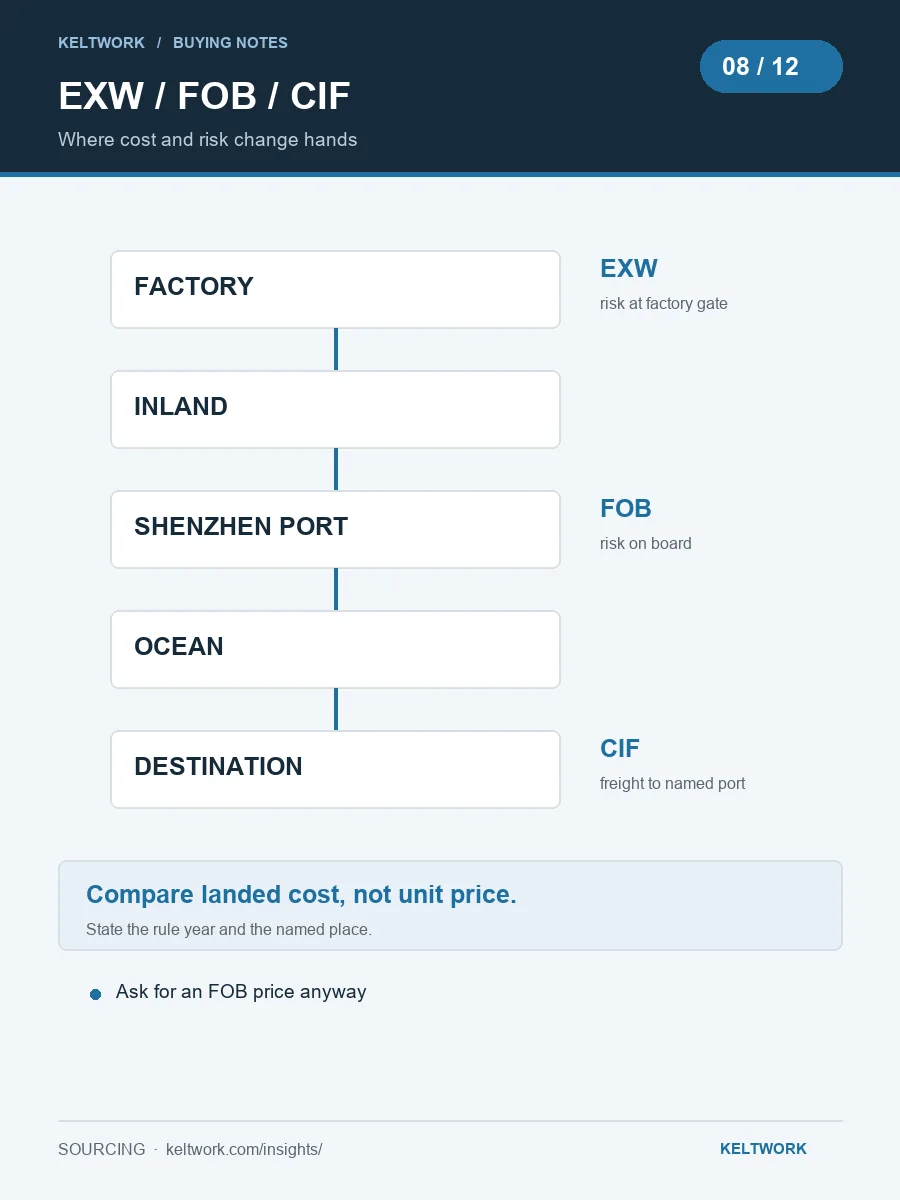
Where each term hands over
| Term | Supplier covers up to | You arrange and pay for | What is commonly hidden |
|---|---|---|---|
| EXW | Goods made available at the factory | Collection, inland freight, export clearance, terminal handling, ocean freight, insurance | Export documentation and local trucking, often underestimated by first-time importers |
| FOB Shenzhen | Goods loaded on board at the named port, export cleared | Ocean freight, insurance, destination charges, duties, inland delivery | Which port and which terminal, and whether “FOB” includes local handling |
| CIF / CFR to destination | Ocean freight (and insurance under CIF) to the named port | Destination charges, duties, inland delivery | Destination terminal fees and the freight component buried in the unit price |
Incoterms rules are published by the International Chamber of Commerce and are revised periodically. State the rule year and the named place explicitly — “FOB Shenzhen, Incoterms 2020” — because “FOB China” is not a usable delivery point. Your customs broker or freight forwarder should confirm the exact application for your shipment; this note is a practical comparison, not legal advice.
Why FOB is the useful comparison baseline
For chair orders, FOB Shenzhen puts the factory in charge of the part it controls well — inland transport, export documentation and loading — and leaves ocean freight with you or your forwarder, where you can compare rates directly. It also gives you a clean point at which to verify the loading: once the goods are on board, the count, the seal and the photographs are fixed.
Converting an EXW quote to FOB is straightforward: add inland trucking from Foshan to the port, export clearance, terminal handling and the loading operation, per container. Converting CIF to FOB means subtracting the ocean freight and insurance component, which the supplier may not want to itemise. If they will not, ask for an FOB price anyway — most will provide it.
Compare landed cost, not unit price: FOB unit price + ocean freight per chair + insurance + destination charges + duty + inland delivery. Freight per chair is driven by carton volume, so the container loading calculation belongs in the same spreadsheet.
Where the risk transfers, and why it matters for claims
Under FOB, risk generally transfers when the goods are on board. Under EXW, it transfers at the factory gate — which means a damaged carton on the truck to the port is your problem, not the supplier’s. That distinction decides when you need insurance to start and who is responsible for a loading discrepancy discovered at destination.
This is also why the inspection point should be written into the commercial terms, not left to habit. A pre-shipment inspection at the factory catches problems while the supplier still owns the goods. Our inspection note describes the four checkpoints; the fourth one — packing — is the one that protects you across the risk transfer.
The documentation that follows the term
Whoever handles export clearance owns the export declaration, the packing list and the commercial invoice that customs will see. Make sure the product description, carton count, gross weight and HS classification are consistent across all three documents, and consistent with the physical cartons. Our note on HS codes and customs documents covers that side of the handover.
Wooden pallets or crates add another requirement: many destinations require treated and marked wood packaging. Agree in the PO who supplies the treatment certificate, and whether pallets are used at all — palletising a chair container typically costs 7–10% of usable volume.
Three questions before you accept a quote
- Which Incoterms rule and which named place? A term without a place is not a term.
- What exactly is inside the unit price? Ask for an itemised list: carton, pallet, inland freight, export clearance, loading, tooling amortisation.
- When and where does inspection happen? And what happens if the shipment fails it — who pays for rework and re-booking?
Where MOQ and term interact
A supplier’s minimum order quantity is often quoted with an assumed term. A 50-piece trial order at EXW can be perfectly viable for the factory and awkward for you; the same 50 pieces at CIF may not be economic at all. Our note on what MOQ really means explains the arithmetic behind the number, and it is worth reading together with the term on the quotation.
For a concrete comparison, take one model — the 2103A or the A010 — and ask for both EXW and FOB Shenzhen on the same quantity. The difference is your real inland and export cost, and it is a number you can use on every subsequent order.
Send us the two quotations and the destination port. We will restate both on the same delivery basis so the comparison is meaningful.
Ask a questionMore notesRelated models
Full specifications and packing data for the chair types discussed above.