
Customs problems on chair orders are rarely about the chair. They come from a description on the invoice that does not match the packing list, a carton count that is off by two, or a wooden pallet without the right treatment mark. Getting the documents consistent is unglamorous work, and it is the cheapest insurance in the whole import process.
Classification is a broker’s decision
Office chairs are generally classified under heading 9401 (seats and parts thereof) in the Harmonized System, but the subheading depends on the material, the presence of a metal frame, whether the chair is upholstered, and the rules of the destination country. Duty rates, anti-dumping measures and any preferential treatment under a trade agreement are destination-specific and can change. We do not quote tariff rates in a specification — your customs broker or the importing entity should confirm the code, the rate and any additional measures before the order is placed.
Do not let the factory choose the HS code for your destination. The supplier can provide an accurate product description, material composition and origin; the importer’s broker determines the classification that will be declared.
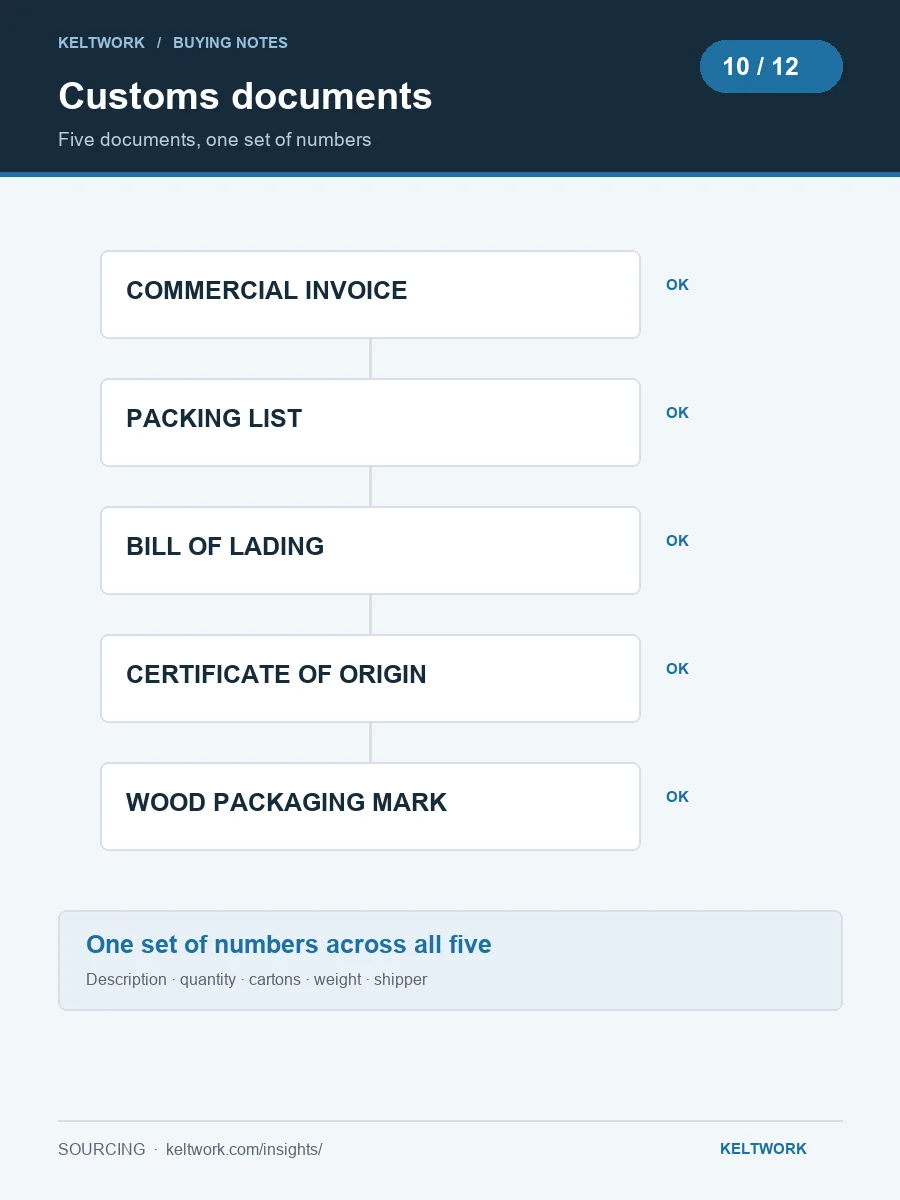
The document set and the number that must agree
| Document | What it does | Common mistake |
|---|---|---|
| Commercial invoice | Declares value, seller, buyer, term and description | Generic description such as “furniture” instead of a specific chair description |
| Packing list | Carton count, dimensions, gross/net weight, CBM | Quantities that do not reconcile with the invoice or the loading photos |
| Bill of lading | Carrier’s receipt and title document | Consignee or notify party details differing from the importer’s instructions |
| Certificate of origin | Supports any preferential duty claim | Requested after shipment, when it is slower and sometimes impossible to issue |
| Wood packaging declaration | Shows pallets or crates meet the destination’s treatment rules | Unmarked or untreated pallets discovered at the port |
The consistency rule is simple: the model description, the quantity, the number of cartons, the gross weight and the shipper details should be identical across the invoice, packing list and bill of lading. Most delays we see are a transcription error in one of those five fields, not a regulatory dispute.
Write a description that survives scrutiny
“Office chair” is weak. A usable commercial description names the product type, the principal materials and the configuration: for example “knocked-down mesh office chair, high back with headrest, nylon five-star base, PU arm pads, model A840-H”. That description can be matched to a product specification, a photograph and a physical carton. It also stops a supplier from quietly combining several different models under one line on the invoice.
If the shipment contains several models — a common case on mixed project orders — list each model on its own line with its own quantity and carton dimensions. The packing list note covers the five fields to check before the documents are issued.
Wood packaging is a separate decision
Palletising a container makes unloading easier and costs 7–10% of usable volume. It also introduces a compliance requirement: many destinations require wood packaging to be heat-treated or fumigated and visibly marked. If you decide to palletise, agree in the purchase order who supplies the pallets, who provides the treatment evidence, and what mark will appear on the wood. If you decide to floor-load, state it explicitly so the supplier does not add pallets at the last minute.
There is a freight dimension here too — the volume cost of pallets is set out in the 40HQ loading note, and the point at which responsibility for the goods transfers is covered in FOB, EXW and CIF compared.
Before the container is booked
- Confirm the declared HS subheading and duty treatment with the importer’s broker, in writing, for the exact model description.
- Ask whether a certificate of origin is needed for any preferential claim, and request it early enough to be issued before sailing.
- Reconcile the three core documents line by line against the final packing list, including the spare-parts carton.
- Decide pallets versus floor loading and record the wood packaging requirement in the PO.
- Keep the loading photographs — carton count per row, container number, seal number — with the document set.
Why the spare-parts carton needs its own line
A 1–2% spare-parts allocation is standard practice on project orders, but it is often shipped as an unlabelled carton and then appears as an unexplained extra unit at destination. List it on the packing list with its own count, weight and value, and describe it as spare parts rather than as chairs. That single line prevents a mismatch between the declared quantity and the physical count — one of the most avoidable causes of a customs query.
The same principle governs the warranty and spare-parts plan: if the parts are documented from the start, they are easy to account for at both ends of the shipment.
Ask us for a model-level product description and a packing list format that reconciles cleanly with your broker’s documents.
Ask a questionMore notesRelated models
Full specifications and packing data for the chair types discussed above.