
A packing list is a pricing document disguised as a logistics form. Three numbers on it — carton dimensions, pieces per carton, and gross weight — decide the freight cost per chair, the number of units a container holds, and whether the quotation you are comparing is even for the same product. Read it before you sign, not after the container is booked.
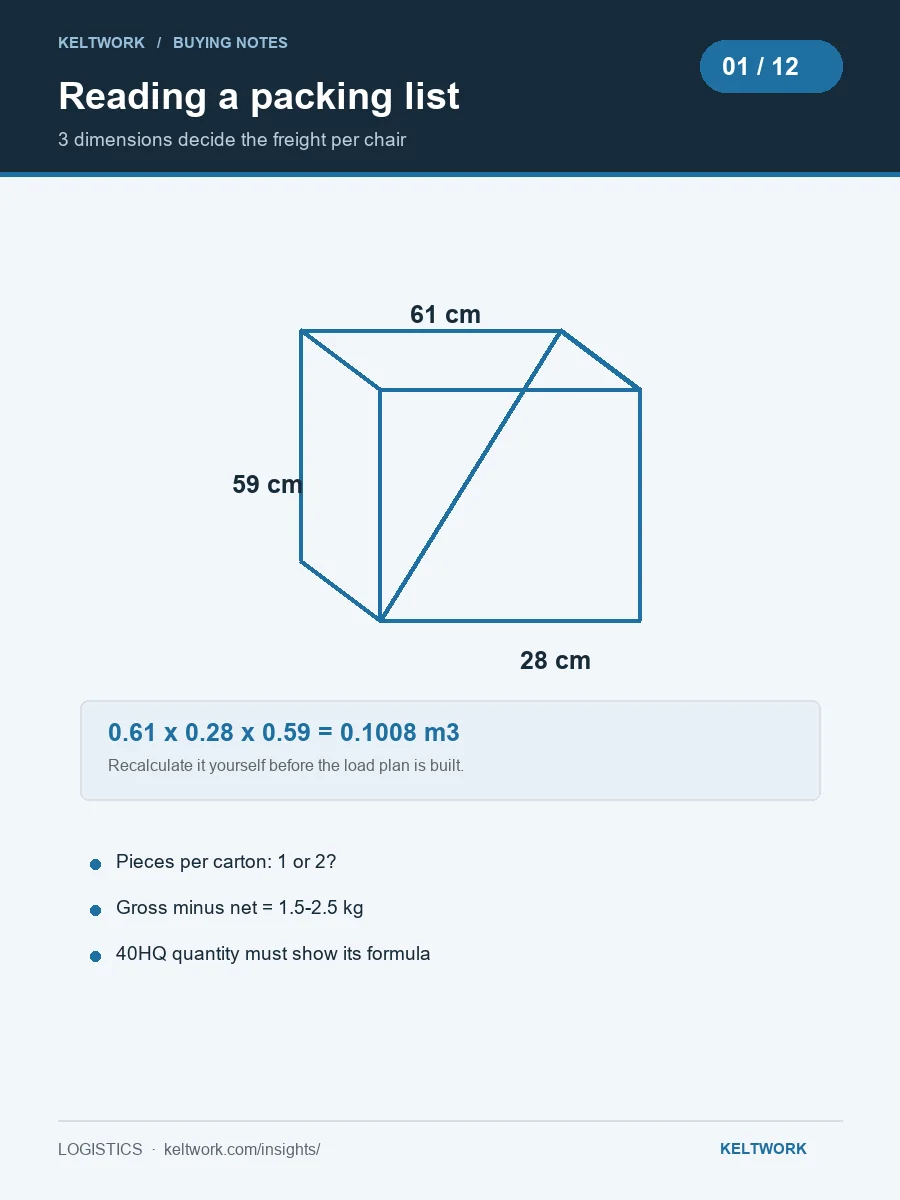
The five fields that matter
Most export packing lists for chairs carry fifteen or twenty columns. Only five change the economics of the order. Ask for these five as a standalone sheet, with units stated explicitly:
| Field | Common notation | What to verify | Red flag |
|---|---|---|---|
| Carton size | 61*28*59 cm | Order of L / W / H, and whether it is outer or inner | Product dimensions pasted into the carton column |
| Pieces per carton | 1 or 2PCS | Whether 2PCS means two chairs or two components | Volume divided by one when the carton holds two |
| CBM per carton | 0.1008 | Recalculate: L x W x H / 1,000,000 | A figure that does not match the three dimensions |
| Gross / net weight | 15 / 13 kg | Difference of 1.5–2.5 kg for carton and fittings | Gross equals net, or a gap above 4 kg |
| 40HQ quantity | 674 pcs | Derive from CBM and a stated fill rate | A round number with no formula behind it |
Do the multiplication yourself
CBM is not an opinion. Take the three carton dimensions in centimetres, multiply them, and divide by one million. A 61 x 28 x 59 cm carton is 0.1008 m³. If the packing list says 0.095, one of the four numbers is wrong, and you need to know which before the freight forwarder builds the load plan.
The second multiplication is the container quantity. At 68 m³ of usable volume and an 85% fill rate, a 0.1008 m³ carton gives roughly 573 pieces. A supplier quoting 674 pieces is either assuming a higher fill rate, a different carton, or floor loading with no dunnage. None of those is wrong by itself — but all three must be stated, not implied. The full derivation is in our note on how many chairs fit in a 40HQ.
One line to add to the PO: “Carton dimensions and CBM per carton are agreed figures with a tolerance of ±1 cm. Pieces per 40HQ is a minimum, calculated at 85% fill of 68 m³ usable volume.”
Why the 2PCS carton causes most disputes
Cantilever and visitor chairs frequently ship two per carton. The carton might read 65*50*53 = 0.172 m³, which looks expensive per chair until you divide by two and get 0.086 m³. We see both halves of this mistake: buyers who reject a competitive quote because they compared 0.172 against 0.100, and buyers who budget freight on 0.086 when the supplier actually meant one chair per carton.
Our 1701D cantilever chair is a good example of why this matters: the flatter frame packs two to a carton, and that single line changes the freight per seat by a third. Always ask the supplier to write “2 chairs per carton” in words, not only “2PCS”.
The same rule applies to knocked-down components. A base strapped outside the main carton is a second handling unit, adds 4–6% to the effective volume, and is a common source of count discrepancies at destination. Ask whether the base, casters and gas lift are inside the carton.
Weight is a sanity check, not a cost driver
Chairs cube out before they weigh out. Six hundred mesh task chairs at 13–15 kg gross are around 8–9 tonnes, well under a 40HQ payload limit. Gross weight is still useful, but as a detector: a 0.10 m³ carton weighing 22 kg is not a chair, it is a chair plus a steel base packed badly, or a transcription error. Compare gross minus net across the whole list — the difference should be consistent for the same carton type.
This is also why light-weighting a chair to save freight is usually wasted effort. Thinner foam or a nylon base instead of aluminium changes the product; only a smaller carton changes the invoice. For the model-level numbers behind this, compare the spec sheets for the A191-H and the 2103A, which share a family but differ in back height and carton size.
What to request before you approve
- A carton photo with a tape measure against two sides. It takes the factory one minute and settles the dimension argument permanently.
- The carton drawing, not just the packing list. The drawing shows where the base and arms sit, which predicts whether the stated dimensions survive production.
- A sample carton from the production batch. Sample-room cartons are often hand-made and slightly smaller than the die-cut run.
- The loading plan with row counts. If the supplier cannot show how 573 cartons fit, the number on the packing list is a guess.
Turn the list into an acceptance document
Once the five fields are agreed, they stop being descriptive and become contractual. State who pays if the shipped quantity falls below the stated minimum because cartons were larger than declared. Ask for loading photographs showing carton count per row, container number and seal number. These four lines remove most of the ambiguity that otherwise turns into a claim three weeks later at destination.
The cost of doing this is about twenty minutes per order. The cost of not doing it is typically one to two US dollars per chair, on every container, for as long as the carton stays wrong.
If you want a packing list checked against your own container plan, send the carton dimensions and the quantity — we will run the numbers and show you where the volume is going.
Ask a questionMore notesRelated models
Full specifications and packing data for the chair types discussed above.