
“Do your chairs pass BIFMA?” is a question that sounds precise and is not. BIFMA X5.1 and EN 1335 are different test regimes built for different markets, and a supplier answering “yes, we can pass” without a report is telling you about intent, not evidence. Here is what the certificates actually establish, and what to ask for instead.
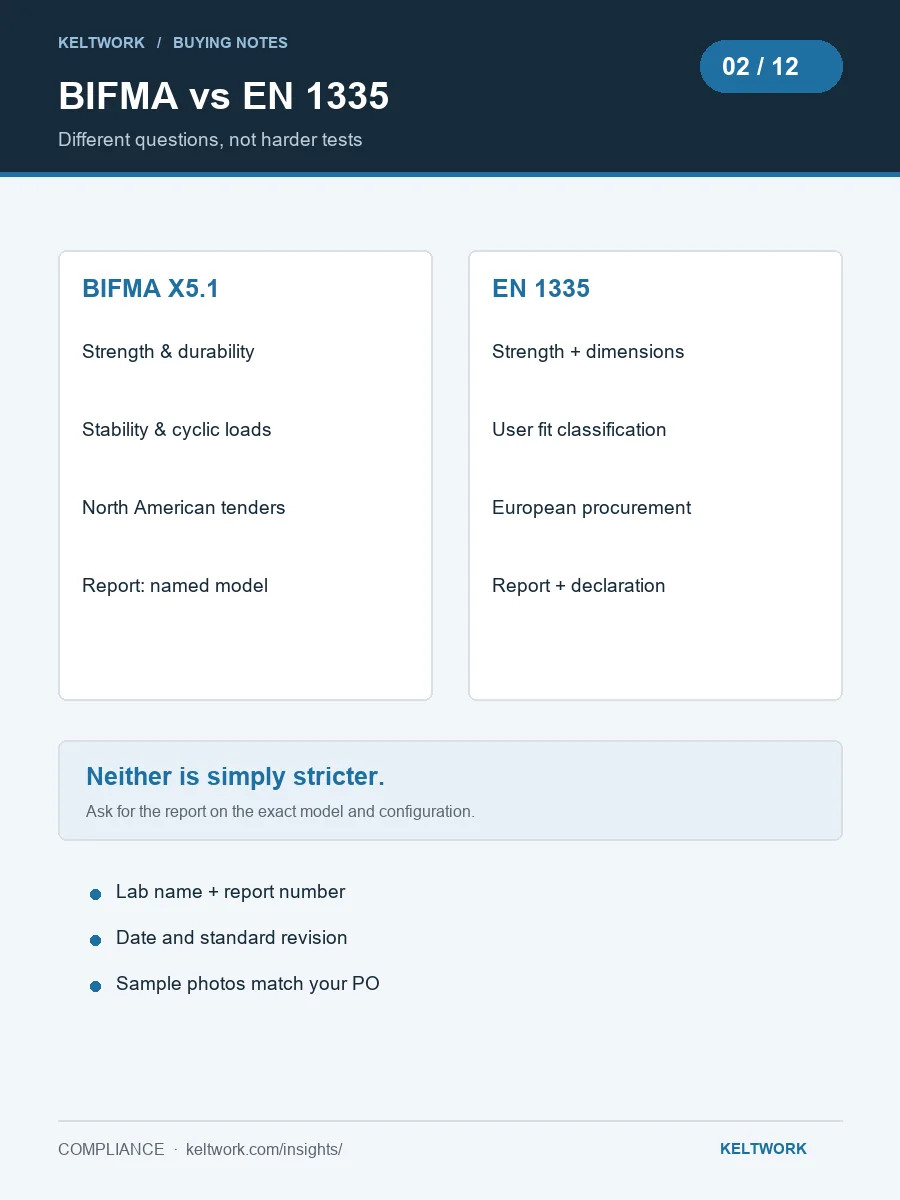
They are not two levels of the same test
BIFMA X5.1 is a North American standard for general-purpose office chairs, built around durability and safety: cyclic loads on the seat, back, arms and base, plus stability and structural strength tests. EN 1335 is a European standard that combines strength and durability with a dimensional and ergonomic classification — it asks whether the chair can be adjusted to fit a given range of users.
Neither is simply “stricter”. A chair can be tested to one and be perfectly serviceable in a market that asks for the other. What matters is the requirement in your tender or your customer’s specification, and whether the evidence matches the exact model being quoted.
| Dimension | BIFMA X5.1 | EN 1335 | What a buyer should do |
|---|---|---|---|
| Primary focus | Strength, durability, stability | Strength, durability, plus dimensions and adjustability | Match the standard named in the tender |
| Typical market | North America, and many international tenders | Europe, and public procurement referencing EN | Confirm with the importer, not the factory |
| User fit | Not the main subject of the test | Dimensional classification is part of the framework | Check seat height and depth ranges separately |
| Evidence | Third-party test report against a named model | Test report plus dimensional declaration | Ask for the report, not a logo |
The four things a real report tells you
When a test report arrives, read the first two pages before the results. Four fields decide whether it has any value:
- Model identification. The report must name the chair, or a clearly defined family with the same base, gas lift, mechanism and back frame. A report for a different model in the same photograph is not a report for your chair.
- Date and revision of the standard. Standards are revised. A decade-old report against a superseded revision may not satisfy a current tender.
- Laboratory and report number. A named, contactable lab with a reference you can verify. A factory “self-test certificate” with no lab identity is a quality statement, not compliance evidence.
- Sample photographs and configuration. The tested sample’s arms, base, castors and headrest should match the quotation. A high-back chair with a headrest is a different configuration from the mid-back in the same series.
Ask this instead of “do you pass”: “Send the full test report for the exact model and configuration in this quotation, including the lab name, report number, date and sample photos.” A genuine report arrives within a day.
Where the specification usually drifts
The most common failure is not a failed test. It is a substituted component. A chair passes with a Class 3 gas lift and a 2.0 mm mechanism plate; the production run ships with a Class 2 cylinder and a lighter plate because the purchase order only said “gas lift” and “tilt mechanism”. The test report stays on file, but it no longer describes the product.
This is why the component-level specification matters as much as the certificate. Our notes on Class 2 vs Class 3 gas lifts and on reading a chassis line cover the two fields most often left vague. Write the exact component into the PO, then reference the report against it.
For a concrete example of how configurations diverge, compare the A840-H and the A841-H: both executive high-back mesh chairs, but a different headrest and frame detail is enough to make a report model-specific.
Certificates are not the same as inspection
A test report describes one sample that was submitted to a lab. It says nothing about the other 600 chairs in your container — the ones with a slightly off-tolerance weld, a loose arm insert, or a carton missing a parts bag. Type testing and shipment inspection answer different questions, and a serious sourcing programme needs both.
Our four-checkpoint inspection note describes the shipment half: incoming components, in-line assembly, function test and the packing check. If a supplier offers a test report but resists a pre-shipment inspection, that imbalance is worth noticing.
A short checklist for your file
- Confirm which standard the destination market or tender actually names. Do not upgrade the requirement on assumption.
- Request the full report for the exact model and configuration, with lab name, report number, date and sample photos.
- Cross-check the tested configuration against your PO component lines: gas lift class, mechanism, base, arms, castors.
- Ask what changed since the report was issued, and whether any component has been substituted.
- Keep a sealed, signed sample from the production run, so the report, the PO and the shipped goods can all be compared to one physical reference.
When no report exists
Small factories often have perfectly good chairs and no current third-party report. That is not automatically disqualifying — testing a specific model is a cost and a lead time, and it is reasonable to agree who pays for it and who owns the result. What is not reasonable is accepting a verbal assurance, a logo on a catalogue, or a report for a different model. If testing is required, put it in the commercial terms with a named model, a named lab and a delivery date for the report.
Send us the standard named in your tender and the model you are considering. We will tell you what evidence we can supply for that exact configuration.
Ask a questionMore notesRelated models
Full specifications and packing data for the chair types discussed above.