
A cantilever chair has no gas lift. That single absence removes the part that fails most often, costs the most in warranty labour, and cannot be repaired at the customer’s site. For meeting rooms, training rooms and canteens, that is a better trade than most buyers realise.
What fails in a task chair, in order
After the casters, the gas lift is the most common failure point on an office chair, and it is the one with the worst economics. A failed cylinder cannot be repaired; the chair has to be taken out of service, a part shipped, and a technician sent. In a 200-chair office that is a routine cost. In a school or a hospital it is a monthly one.
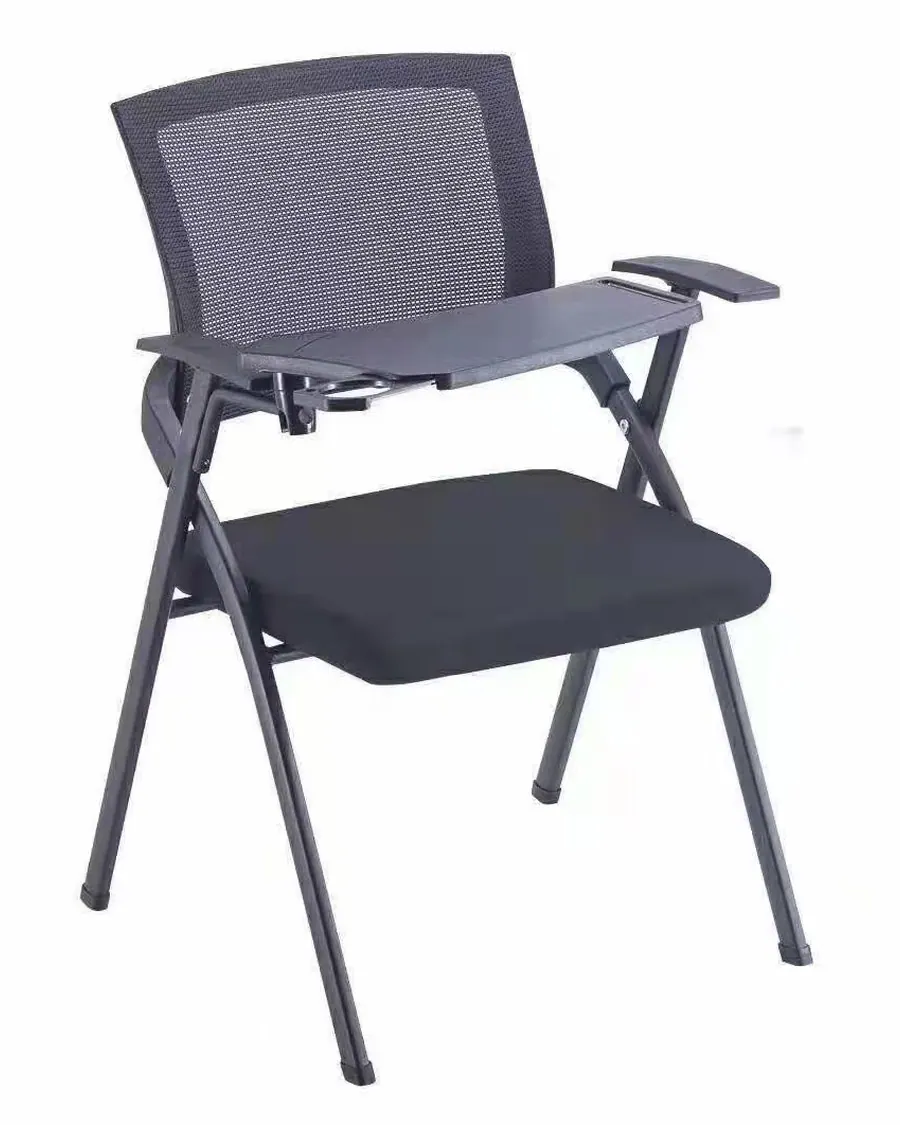
A cantilever frame replaces the cylinder, the five-star base and the swivel mechanism with a single bent steel tube. There is nothing to leak, nothing to seize, and nothing to adjust.
How the frame is built, and where it fails instead
The standard construction is a 25 × 2.0 mm steel tube, bent, welded to a seat plate, with the rear of the frame running down to two floor glides. Better frames are 30 × 2.0 mm or use a rectangular section for the legs.
Cantilever chairs do have failure modes, and they are all in one place: the weld at the bend where the vertical leg meets the seat rail. That joint takes the full moment of a person leaning back. A frame with a gusset or a full-perimeter weld lasts; a frame with two tack welds does not, and it fails at the worst moment.
Two tests worth asking about:
- Static load. EN 16139 for contract seating sets load levels by intended use. Level 2 (severe contract use) tests around 160 kg on the seat and a rearward force on the back. Ask which level, and ask for the report.
- Fatigue. Repeated load cycles on the seat and back. A frame that passes static load and fails fatigue is a frame that cracks in year two.
What you give up
Height adjustment. A cantilever seat sits at a fixed height, typically 440 to 460 mm. That is right for a 1.70 to 1.80 m user and wrong for anyone much shorter or taller. It is not a defect; it is a category. If the users vary in height, this is the wrong chair.
Lumbar support. Most cantilever chairs have a fixed back with modest contouring. For a two-hour meeting that is fine. For eight hours it is not, and no amount of padding compensates.
Floor footprint. The frame is narrower than a five-star base, which is an advantage in a stacked or tight layout, but it also means the load is concentrated on two glides rather than five casters. On a soft floor or a raised access floor, check the point load.
| Cantilever | Gas-lift task chair | |
|---|---|---|
| Moving parts | None | Cylinder, swivel, casters |
| Most likely failure | Weld at the frame bend | Gas lift, casters |
| Field repair | Rarely needed | Cylinder swap, needs tools |
| Height range | Fixed | 100 – 140 mm |
| Indicative FOB | 20 – 30% lower | Baseline |
| Carton | Smaller, flat | Larger, taller |
| Best for | Meeting, training, canteen, waiting | Task, control room, 8-hour use |
The freight bonus nobody counts
A cantilever chair packs flatter than a task chair — no five-star base, no cylinder, a thinner carton. Practically that is 0.075 to 0.09 m³ against 0.11 to 0.13 m³. On a 40HQ that is a difference of 150 to 200 pieces, which shows up as USD 1 to 2 per chair in freight before any product cost saving.
For a project buyer comparing landed cost rather than FOB, the cantilever usually wins by more than the price list suggests.
Where it is the wrong answer
Be honest with the customer about three situations: users who need a specific seat height for a fixed-height desk; anyone sitting more than four hours a day; and buildings where chairs are shared between people of very different sizes. In those cases the gas lift is not a luxury, it is the reason the chair works.
A mixed project — task chairs for the workstations, cantilevers for the meeting rooms and the canteen — is usually the cheapest correct answer, and it is the layout most of our contract buyers end up with.
Send the floor plan and the headcount per room. We will propose a split between task and cantilever seating with the landed cost of each.
Ask a questionTraining & stackable chairs