
“Three-year warranty” is a headline, not a specification. On an office chair, the parts that fail first are not the ones that last three years, and a warranty that treats the whole chair as one item will generate an argument at exactly the moment you need a replacement part. Write the coverage by component, add a spare-parts plan, and the warranty becomes a serviceable document.
Which parts actually fail
Field returns on office chairs cluster around a small number of components: gas lifts that slowly lose height, castors that crack or lose their stem fit, arm tops that soften or peel, tilt mechanisms that develop play, and mesh that loses tension. The back frame, the seat board and the five-star base fail far less often. A single blanket warranty obscures that difference.
| Component | Common failure mode | Suggested treatment in the terms |
|---|---|---|
| Gas lift | Sinks under load, or will not hold height | Named class and cycle test; longest coverage band; spare units in every container |
| Castors | Cracked wheel, loose stem, poor rolling on hard floors | Treated as a wear item with a spare allocation |
| Arm tops / PU pads | Softening, tackiness, peeling skin in humid climates | Wear item; spare pads supplied rather than whole assemblies |
| Tilt mechanism | Play at the pivot, lock that slips | Named part number and cycle test; coverage tied to the PO component line |
| Mesh and upholstery | Loss of tension, abrasion, seam failure | Separate band; state what counts as normal wear |
| Frame, base, seat board | Rare, usually impact damage | Longest band; exclude obvious misuse explicitly |
Spare parts beat claim paperwork
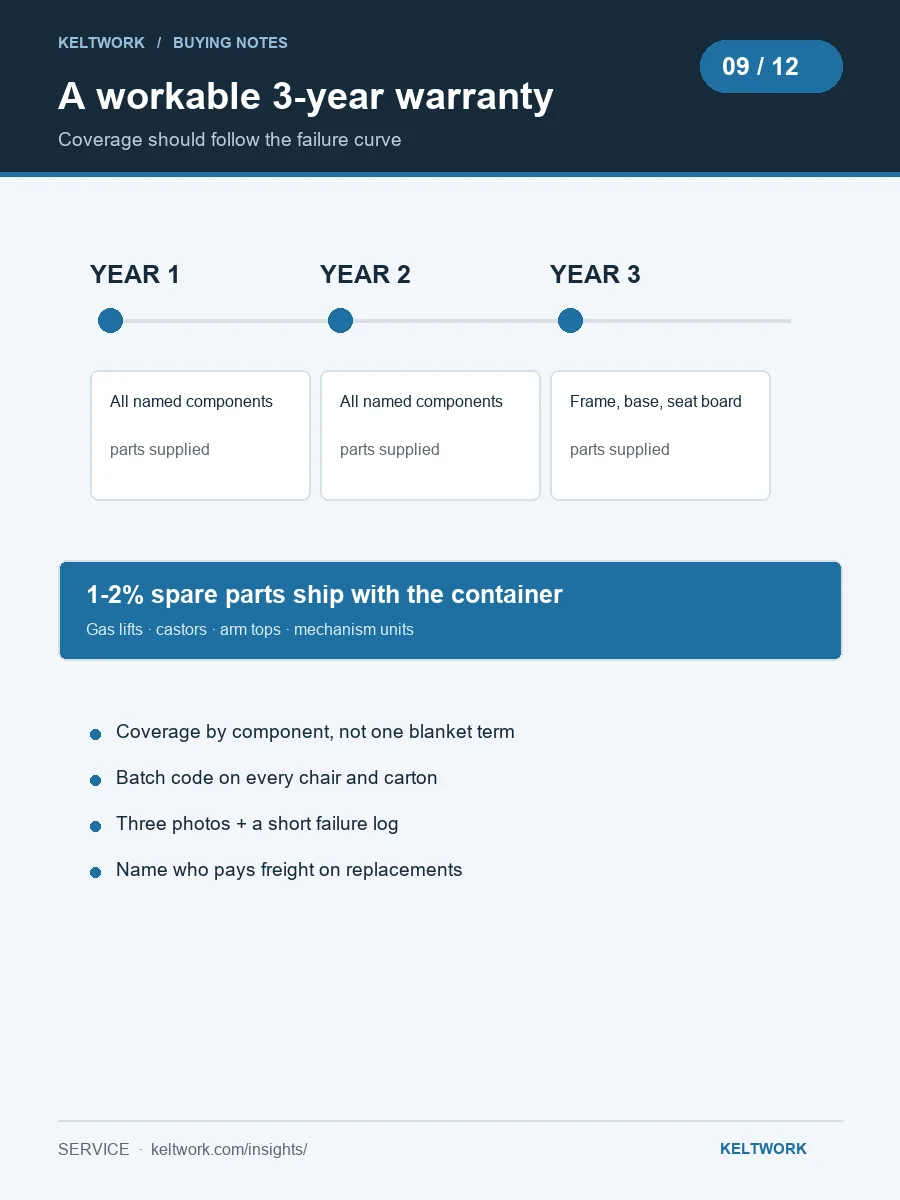
For an export project, shipping a 1–2% spare parts allocation with the container is almost always cheaper than processing individual claims six months later. A carton of gas lifts, castors, arm tops and a few mechanism units costs little in volume, arrives with the goods, and lets the local dealer fix a chair the same day. Ask for the allocation to be itemised on the packing list — otherwise it tends to disappear into the container count.
Ask for three things in the terms: coverage by component, a spare-parts list with quantities, and a claim procedure that says what evidence is needed (photos, batch code, carton label) and how replacement parts ship.
Why the component specification decides the claim
Warranty disputes usually turn on one question: is the part in the chair the part that was specified? If the PO says only “gas lift” and “tilt mechanism”, a Class 2 cylinder and a lighter chassis are technically compliant, and there is nothing to claim against. Our notes on gas lift classes and chassis shorthand exist for exactly this reason.
For an executive model such as the A840-H or the A841-H, where the gas lift, headrest and mechanism carry more of the comfort promise, tying the warranty to named component part numbers is worth the extra line in the PO.
Evidence that makes a claim resolvable
- Batch or carton code printed on the chair or the carton label, so a set of failures can be traced to one production run.
- Three photographs — the whole chair, the failed part, and the label — plus a short video if the fault is movement rather than appearance.
- The approved sample photograph from the PO, showing the underside with part numbers, for comparison.
- A simple failure log with dates and quantities. Ten sinks in week two is a batch problem; one in month eight is a wear item.
These are the same documents a pre-shipment inspection produces. Our inspection note explains where to capture them before the goods leave, when the supplier still owns the problem.
What to exclude, and how to say it
Every chair warranty excludes some things. State them plainly rather than relying on a general “fair wear and tear” clause: incorrect assembly, use beyond the stated load, replacement with non-supplied parts, damage in transit after the risk transfer point, and surface wear on PU and upholstery. The point of listing exclusions is not to narrow the warranty — it is to avoid a two-month email exchange about a scratched arm pad.
Also state where the warranty is serviced. For a container shipped to a distributor, the practical answer is almost always “parts supplied free, labour handled locally”. Put that in writing and name who pays the freight on the replacement parts.
A workable structure for a three-year term
- Years 1–2: all named components, parts supplied free, with a 1–2% spare allocation shipped with the order.
- Year 3: frame, base and seat board at full coverage; moving parts and surfaces at a reduced or parts-only band.
- Throughout: wear items (castors, arm tops) handled through spares rather than claim-by-claim.
That structure follows the actual failure curve, costs less to administer than a blanket promise, and gives the end customer a faster fix. It is also far easier to price, which is why a supplier who has thought about service will usually agree to it quickly.
Ask us for a component-level warranty schedule and spare-parts list for the models on your project.
Ask a questionMore notesRelated models
Full specifications and packing data for the chair types discussed above.