
Nylon or aluminium five-star base is one of the few chair decisions where the cheaper option is frequently the right one. The trade is not “plastic versus metal”; it is weight, impact behaviour, long-term static load and what the extra kilograms do to a specification that is already constrained by carton volume rather than by weight.
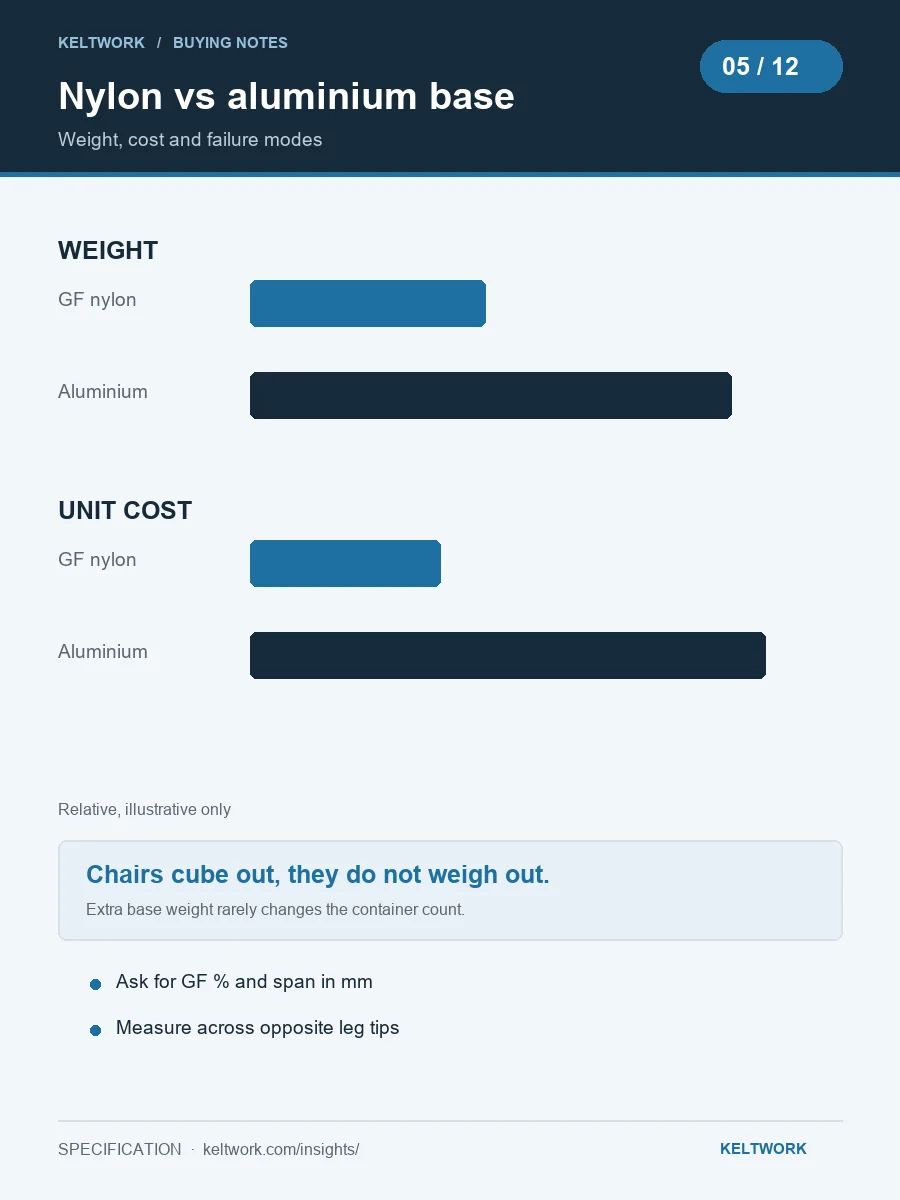
What each material actually gives you
| Factor | Glass-filled nylon | Die-cast aluminium |
|---|---|---|
| Weight | Lighter; typically a small part of gross carton weight | Heavier, often by 1.5–3 kg per chair |
| Unit cost | Lower, and widely available in standard tooling | Higher, and polished finishes add more |
| Impact behaviour | Can crack under a sharp point load, especially in cold conditions | Tends to bend or dent rather than shatter |
| Long-term load | Creep is the concern under sustained high static load | Stable under sustained load |
| Finish | Moulded colour, usually black | Polished, painted or chrome-effect |
The important word in the first column is glass-filled. A nylon base with glass-fibre reinforcement is a different component from an unfilled nylon moulding, and the difference is not visible from the outside. If the spec sheet says only “nylon base”, ask for the reinforcement percentage and the load test result. A good reinforced nylon base is more than adequate for normal office use; a cheap unfilled one is the part that shows up in warranty photographs.
Diameter matters more than material for stability
A 320 mm base and a 350 mm base of the same material do not behave the same. The wider footprint resists tipping when a user leans back or pushes off a desk, and it changes how the chair interacts with a castor that has rolled under the seat. Spec sheets often quote a base size such as “320 高脚” without saying whether that is the radius, the diameter or an internal series code. Ask for the physical span in millimetres and measure it on the sample.
The castors are the other half of that system: hard wheels for carpet, softer polyurethane for hard flooring, and a stem diameter that must match the base socket. A base specification that does not mention the castor stem is incomplete.
Why the extra weight rarely costs you freight
Chairs cube out, they do not weigh out. Six hundred chairs at 13–15 kg gross are around 8–9 tonnes, comfortably under a 40HQ payload. Adding two kilograms of aluminium per chair moves the total by roughly 1.2 tonnes and does not change the container count. The cost of aluminium is therefore almost entirely in the unit price and the finishing, not in the shipping — a point worth making when a supplier quotes freight as a reason to upgrade.
Where weight does matter is handling: a heavier chair is slower to move during installation, and heavier cartons are more likely to be dropped. For a multi-floor fit-out, that is a real labour consideration. The volume arithmetic is set out in our 40HQ loading note.
Rule of thumb: specify reinforced nylon for general office and project seating; specify aluminium where the tender calls for it, where loads are unusually high, or where a polished finish is part of the design brief. Do not pay for aluminium to solve a stability problem that a wider base fixes.
Where you will see the difference in a range
Executive models are the ones most often quoted with an aluminium or polished base, because the finish is visible and the price point absorbs it. Compare the A840-H with the A807-H and a standard task model such as the 1701A: the base specification is one of the lines that separates them, and it is a line a quotation can change without changing the photograph.
The same substitution risk applies to the mechanism above the base; our note on reading a chassis line covers that half of the assembly.
What to put in the purchase order
- Material and reinforcement: “glass-filled nylon, [X]% GF” or “die-cast aluminium alloy [grade]”.
- Physical span in mm, measured across opposite leg tips, with a tolerance.
- Castor specification: wheel diameter, material, stem diameter, and whether a brake version is required.
- Load test reference for the assembled base, with the test method named.
- A underside photograph of the approved sample, including any moulded part number, attached to the PO.
The inspection check that catches most of it
At pre-shipment inspection, pull three cartons at random, weigh the chair, measure the base span, and compare the underside against the approved photograph. A material substitution that survives the quotation stage almost never survives those three measurements. It takes about ten minutes and is the cheapest insurance on the whole component list.
Send us the base line from a specification and we will confirm what is actually being quoted, including the castor pairing.
Ask a questionBrowse modelsRelated models
Full specifications and packing data for the chair types discussed above.