
The chassis line on a Chinese chair spec sheet is usually four characters long and carries more cost and more failure risk than any other component. “2.0 butterfly mechanism”, “single-hand tilt”, “three-position lock” — these are shorthand, and two suppliers can use the same words for different parts. Here is how to turn the shorthand into something you can put in a purchase order.
What the mechanism actually does
The chassis connects the seat to the gas lift and controls three things: whether the back reclines, whether the seat moves with it, and where the recline can be locked. Everything else on the chair — the mesh, the arms, the base — is comparatively easy to see and compare. The mechanism is hidden, which is exactly why it is the first place a quotation can quietly change.
| Term on the sheet | What it usually means | Ask the supplier to state |
|---|---|---|
| 2.0 butterfly / 蝴蝶底盘 | A plate-based tilt unit; the number commonly refers to a plate gauge or series | Plate thickness in mm, steel grade, and the maker’s part number |
| Single-hand / single-lever | One lever handles height and tilt lock | Which lever does what, and whether tilt lock is independent of height |
| Multi-position lock | Recline can be locked at several angles | Number of lock positions and the recline angle range in degrees |
| Free tilt / free float | Back follows the user with a tension spring | Tension adjustment range and whether there is a lock at all |
| Synchro | Seat and back move at different ratios | The ratio, and whether it is a genuine synchro unit or a simple hinge |
The “2.0” problem
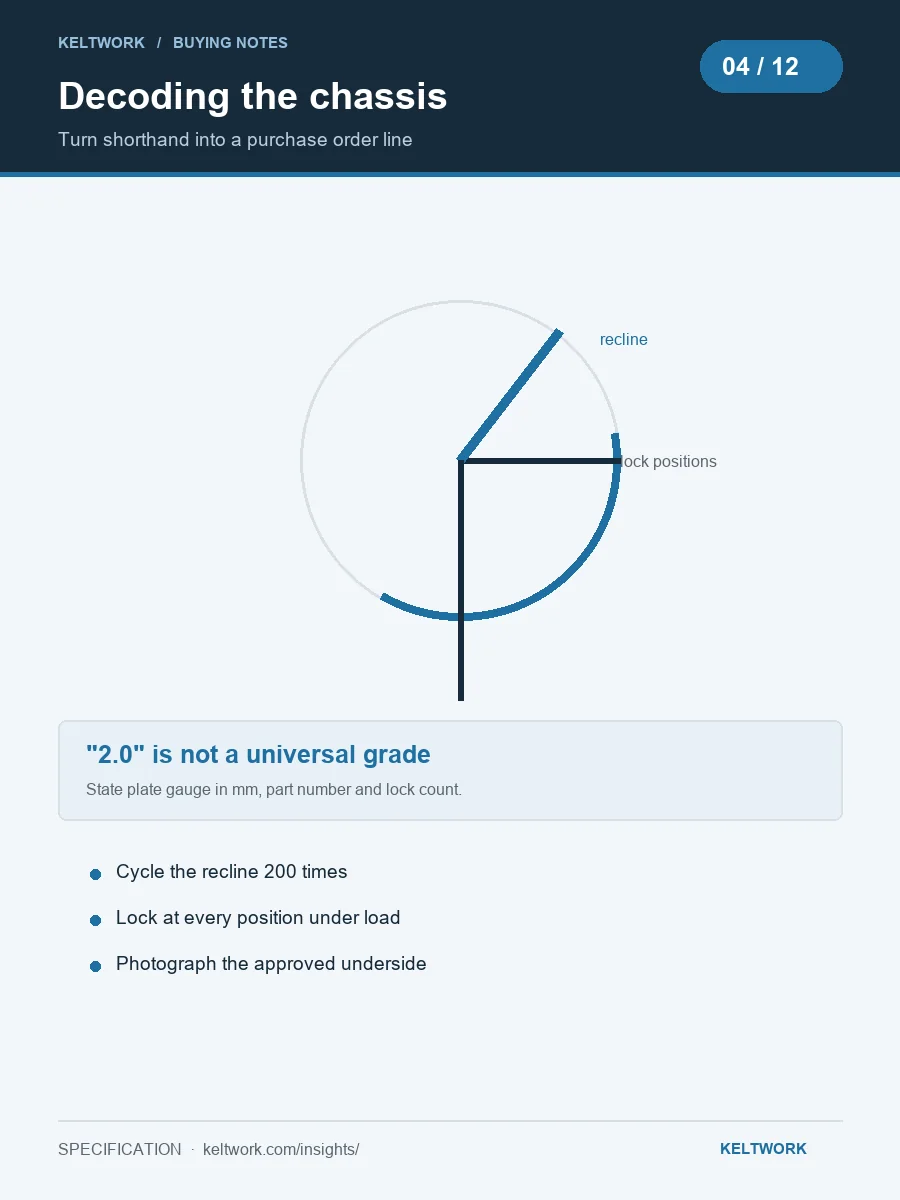
A number in front of a mechanism name is not a universal grade. In most Foshan spec sheets it refers to a plate gauge or an internal series code, and the same “2.0” can be attached to units with different steel, different spring sets and different cycle life. Ask for the thickness in millimetres and the supplier’s part number. If the answer is “it is standard”, the line is not specified.
The same applies to the gas lift sitting inside it. A mechanism and a cylinder are a paired assembly: the taper, the stroke and the load rating have to match. Our note on Class 2 vs Class 3 gas lifts explains why the cylinder is the part that fails first in hot climates, and why the mechanism cannot compensate for a cheap one.
Two chairs, two chassis lines
Compare the 2002A, specified with a butterfly mechanism, against the 2103A with a single-hand tilt. Both are high-back mesh chairs from the same supply chain, and the price difference is partly the mechanism. If a quotation replaces one with the other without changing the model code, that is not a minor substitution — it changes how the chair feels every time the user leans back.
Write it like this: “Tilt mechanism: [maker part number], steel plate [X] mm, [N]-position lock, recline range [A]–[B] degrees, tension adjustable, matched to [Class 3] gas lift. No substitution without written approval.”
What to test on the sample
- Cycle the recline 200 times under load and listen for new play at the pivot. A mechanism that develops a click in the first day will develop a warranty claim in the first year.
- Lock at every position and push firmly on the back. A lock that slips under a moderate load is not a lock.
- Operate the height lever with the chair loaded and again unloaded. The two should feel the same; a difference points to a mismatched cylinder taper.
- Measure the recline range with a simple angle app. It costs nothing and turns an adjective into a number.
- Photograph the underside of the approved sample, including any stamped part number. That photo becomes the reference for the production run.
Where mechanism choice meets freight
A synchro or multi-lock unit is heavier and sometimes deeper than a simple tilt, which can add a centimetre to the carton height. On its own that is trivial; across 600 chairs in one container it is not. If you are comparing two chassis options, ask for the carton dimension for each rather than assuming the packing list is unchanged. The method for checking that is in reading a packing list.
The failure modes worth asking about
Mechanism complaints on export orders cluster around three causes: a loose pivot after a few months of cycling, a lock that will not engage because the cable or lever was adjusted at a different seat height, and a spring that loses tension in a hot, humid warehouse before the chair is even unpacked. None of these show up in a photograph, and all of them are cheap to prevent at the specification stage. Ask what cycle test the unit has passed, and ask for the result for the exact part number in your order.
Send us the chassis line from a quotation you are comparing and we will translate it into plain component terms with the unit cost impact.
Ask a questionBrowse modelsRelated models
Full specifications and packing data for the chair types discussed above.